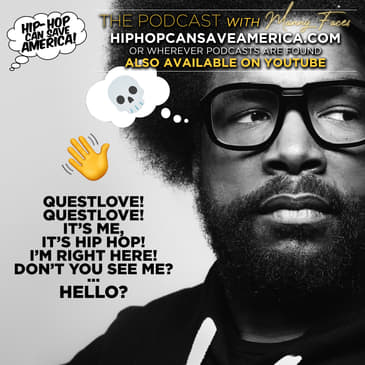
In the wake of the Kendrick Lamar vs. Drake rap beef, opinions and hot takes have flooded in about the battle, including some from high-profile figures like Stevie Wonder and Rick Ross. In this video, I challenge one controversial opinion from the respected Hip Hop historian and musicologist, Questlove.
Is Hip Hop really "truly dead," or is Questlove's knee-jerk statement causing more harm than good to the culture he claims to care about?
---
Hip-Hop Can Save America! with Manny Faces is a Manny Faces Media production, in association with The Center for Hip-Hop Advocacy.
Links and resources:
SHOW WEBSITE: https://www.hiphopcansaveamerica.com
ON YOUTUBE: https://www.hiphopcansaveamerica.com/watch
MANNY FACES: https://www.mannyfaces.com
NEWSLETTER (free!): https://mannyfaces.substack.com
SUPPORT QUALITY INDIE HIP HOP JOURNALISM: https://www.patreon.com/mannyfaces
Manny Faces Media (podcast production company): https://www.mannyfacesmedia.com
The Center for Hip-Hop Advocacy: https://www.hiphopadvocacy.org
SPONSORS / FRIENDS:
The Mixtape Museum: https://www.mixtapemuseum.org
Hip-Hop Hacks: https://www.hiphophacks.com
Hip-Hop Can Save America! is produced, written, edited, smacked, flipped, rubbed down, and distributed by Manny Faces.
Eternal thanks to Consulting Producer, Sommer McCoy.
[00:00:00] I am Brother Cornel West and this is Hip-Hop Can Save America
[00:00:07] Peace and love everybody, it's your man Manny Faces.
[00:00:12] Just wanted to let you know that Hip-Hop Can Save America is now available as a live stream show every Monday night 9 p.m. Eastern Time on YouTube.
[00:00:20] You can find it at hiphopcansaveamerica.com slash watch.
[00:00:24] Excerpts from that show will be played here on the audio feed so you'll still get the good interviews that you've been used to.
[00:00:30] But check out the live stream and check out my free Substack newsletter at mannyfaces.substack.com that's filled with all kinds of stories of hip-hop innovation, inspiration, and generally hip-hop news that isn't about dumb s***.
[00:00:42] For everything Hip-Hop Can Save America, hiphopcansaveamerica.com. For everything Manny Faces, mannyfaces.com.
[00:00:48] And if you find value in this work, you can support it.
[00:00:51] We'd love to have you aboard as a supporter at patreon.com slash mannyfaces.
[00:00:55] Now let's go.
[00:00:58] The thing about hip-hop today is it's smart.
[00:01:03] It's insightful.
[00:01:06] The way that they can communicate a complex message in a very short space is remarkable.
[00:01:13] And a lot of these kids, they're not going to be reading the New York Times.
[00:01:16] That's not how they're getting their information.
[00:01:27] Show them what peace can do when they're reached for you.
[00:01:30] My hip-hop will rock the shop, the nation.
[00:01:33] Rap is something you do. Hip-hop is something you live.
[00:01:35] So hip-hop didn't invent anything. But hip-hop reinvented everything.
[00:01:45] In 2013, New York Magazine published an article titled, Did 1993 Change Everything?
[00:01:51] In it, rapper's speech from Arrested Development was quoted saying, Public enemy revolutionized the subject matter in hip-hop.
[00:01:56] But then you had a tribe called Quest, De La Soul, Brand Nubian telling people that black is proud, that diversity is cool.
[00:02:03] We're not all one color, but we can still be one in thought.
[00:02:06] In 2013, NPR heralded 1993 as the chronic as an audio document of the LA riots and called 1993, rap's greatest year.
[00:02:15] Earlier, in 2003, Vibe Magazine was already up on it, publishing 1993, the year hip-hop and R&B conquered the world.
[00:02:22] Running down a laundry list of iconic artists and groups that today are known as iconic by rap fans and the general public alike.
[00:02:29] But in 1993, when all of this incredible music and art was bursting into the mainstream, the general public was being told something very different.
[00:02:38] I've looked through the archives of the New York Times, known as the nation's paper of record.
[00:02:43] And I've tallied up the articles that were being written about rap and hip-hop culture in 1993.
[00:02:48] Contrary to what was being written about in hindsight years later, the public was being told a much different story.
[00:02:54] Rap star and two others accused of murder, radio station bans harmful music, rap star and two friends indicted in sexual assault, Harlem protest of rap lyrics draws debate and steamroller.
[00:03:05] There were virtually zero positive representations of the music and or the culture in the New York Times or presumably much other mainstream media in 1993.
[00:03:16] Adding to that, 1993 was the year C. Dolores Tucker would wage her infamous war on rap.
[00:03:21] Now look, hip-hop media, which was in its heyday at the time, was doing its best, profiling that litany of groundbreakingly creative and diverse artists.
[00:03:29] Yet the rest of the country was being told that rap and by extension those associated with it were nothing more than violent thugs.
[00:03:37] And that the music and the culture and its participants had no redeeming value to society.
[00:03:42] You know, in the first 20 years, rap and hip-hop culture was seen as a fad, party music if anything, not even worthy of its own category.
[00:03:49] Simply lumped in as part of R&B or disco and billboard for example.
[00:03:54] Post 1993 however, in part thanks to this avalanche of biased press and its effect on public perception, the perception that hip-hop music and culture has had to continuously confront is that it is violent, misogynistic and hateful.
[00:04:09] In 2015, I co-authored a research study with social psychologist Dr. Joyce Sever that aimed to gauge public perception of hip-hop.
[00:04:16] Among several really interesting takeaways, one was that 67% of people who don't even listen to rap think that it's negative.
[00:04:24] Think about that, it's important. Also keep in mind that unsure was an option, which is what I would say if you asked me what I think about music I've never heard.
[00:04:32] Now if you're a subscriber to this channel or my newsletter, you probably already know how unfair this sort of thinking is to the entirety of hip-hop.
[00:04:38] Even if we just focus on its artistic participants.
[00:04:41] I would think most would agree that the depth and breadth of what hip-hop produces as a genre alone is as vast as the human experience itself.
[00:04:48] From street ciphers to a Pulitzer Prize, from Ratchet to Revolutionary.
[00:04:52] And while negative can be subjective, sure there are aspects of the music that we can all agree aren't representative of the genius and creativity of the genre as a whole.
[00:05:01] But that's the point, that an entire genre exists which should never have to be whittled down to negative.
[00:05:07] Now we did ask survey participants about rap in particular, but since most people equate hip-hop and rap, it's not a far reach to assume that many of these respondents also aren't familiar with hip-hop culture.
[00:05:17] And that most would likely feel the same way if they were specifically asked about hip-hop in general.
[00:05:22] Which to me is even worse because it's on a societal level where hip-hop's true positive potential shines.
[00:05:29] As we cover here on the Hip-Hop Can Save America podcast and livestream show, there's so many areas in which hip-hop is being used to help improve humanity.
[00:05:37] In schools, in mental health facilities, in physical and occupational therapy, in politics and activism.
[00:05:43] All of these in ways that are completely unique to hip-hop.
[00:05:46] These intersections with nearly every aspect of modern culture, many of them inspiring, have gone global.
[00:05:52] They cross every possible border, ethnic, cultural, generational, linguistic, religious, ideological.
[00:05:58] Hip-hop is everywhere. Hip-hop is expansive. Much of it is extremely positive. Hip-hop is truly alive.
[00:06:07] So what's the problem?
[00:06:09] Well, the problem is that hip-hop's reputation of being nothing more than a violent, misogynistic, talentless genre continues to proceed it.
[00:06:17] Despite the illusions that I just made and the hundreds of examples that I could and often do provide.
[00:06:23] But it's not hard to see why. Remember, with media, if it bleeds, it leads.
[00:06:27] That's no different when it comes to The New York Times in 1993 or today on your local news or cable networks.
[00:06:33] And we can and should talk about how coverage in all of these arenas have long skewed against people of color in insidious ways.
[00:06:40] We can see this currently with the purposeful racist and xenophobic fear-mongering around immigrants or pro-Palestinian protesters, for example.
[00:06:47] In all of these cases and throughout history, these harmful stereotypes are born and nurtured based on the suppositions of often just a few powerful individuals with big megaphones.
[00:06:57] And then fueled through repetition and amplification to become an irreversible part of the zeitgeist.
[00:07:03] With hip hop, it doesn't help when, generally speaking, the only news deemed worthy of making the rounds in the news cycle are stories about a fallen mogul or a rap battle between two of the industry's biggest stars.
[00:07:15] Both of which, though quickly and repeatedly emphasized, are full of disparaging personal, salacious accusations and commentary.
[00:07:21] Just the kind of stuff they love in the media.
[00:07:24] But this is to be expected. Much good work and good trouble go unreported all the time.
[00:07:30] The point is, people never really get to hear about the positive side of hip hop.
[00:07:34] For instance, at around the same time as the news was all a flutter about the Kendrick Drake affair,
[00:07:39] the eighth annual incarnation of a youth-centered hip hop education conference was happening at Harvard's Graduate School of Education, an inspiring event showcasing brilliance in hip hop based education practices.
[00:07:50] Also around the same time, there were several prominent hip hop artists up in Albany talking to state legislators about the dangerous trend of rap lyrics being included as evidence in trials.
[00:08:00] Seemingly no media at all covered the former and only vibe that I could find touched on the latter.
[00:08:07] So I was intrigued. While I was writing this, I checked some of the major outlets to see what they were covering about hip hop.
[00:08:13] Now more than a couple weeks removed from the height of the 2024 battle of the rap titans.
[00:08:18] Surely there would be something happening in all of hip hop that would be worthy of covering in the news.
[00:08:23] Or would this random snapshot in time prove again that mass media is only interested in the negative aspects of the music and the culture?
[00:08:30] Here's what I found on the Fox News Entertainment page.
[00:08:33] I actually couldn't find any stories about hip hop music or culture at all, except this whole section that was devoted to Diddy.
[00:08:40] At the top of the entertainment page on CNN, quote, Questlove was not happy with Drake and Kendrick Lamar's beef.
[00:08:46] Nobody won the war. All right, hold that thought for a minute. We're getting to him.
[00:08:51] And on the home page of MSNBC in the video section, an eight minute clip from the beat with Ari Melber.
[00:08:56] Ari Melber breaks down the Kendrick Lamar and Drake rap battle.
[00:09:00] Now Melber is an outspoken hip hop fan. Often he intertwines lyrics on his show.
[00:09:04] He interviews artists and he takes great pains to portray hip hop in its best light.
[00:09:08] That being said, again, the only hip hop he generally covers is that which reaches a level of controversy,
[00:09:13] which requires his brand of Melber's splaining to his audience.
[00:09:16] So in that regard, it's kind of like Macklemore's pro-Palestine Heinz Hall.
[00:09:20] It's cool and all, but there are others who are doing it that aren't white and famous.
[00:09:24] And it'd be cool if their voices were just as prominent. But I'm digressing.
[00:09:27] A decent job by Melber to portray the beef in a positive light.
[00:09:30] But in the end, it's still just rap beef to the I only read the headline folks,
[00:09:34] which to most people, as we've covered means rap equals violence.
[00:09:40] In fact, that's the overall knee-jerk reaction to rap beef, even amongst rap fans.
[00:09:44] Remember what happened to Tupac and Biggie, people have said.
[00:09:47] Some of those folks genuinely care about the music and the communities that it's typically attached to
[00:09:51] and they're simply offering that as a plea, a warning,
[00:09:54] to not let these conflicts echo the tragic circumstances of that particular conflict. That's fair.
[00:09:59] Others, however, usually less connected to hip hop music and culture,
[00:10:02] use it as low-hanging fuel to bolster their position that rap is violent.
[00:10:05] Rappers are violent. Rap fans approve violence.
[00:10:08] And these are the only things that rap or hip hop can offer.
[00:10:11] Now, the result of this connecting any rap battle to Biggie and Tupac
[00:10:16] only helps strengthen this misperception that rap battles inevitably lead to violence
[00:10:20] because rap and rappers are violent.
[00:10:23] All of this continuously spills over and affects the people and the organizations
[00:10:28] that are involved in hip hop in ways that are not any of that.
[00:10:32] I mean, it's not much different than having to prove yourself
[00:10:35] to people who have preconceived notions of you based on your race, your gender,
[00:10:39] your religion, your physical or cognitive abilities, or any number of isms.
[00:10:44] Which is why it's more than an insignificant throwaway line
[00:10:47] when at the end of a rant about the Kendrick and Drake battle,
[00:10:51] Questlove states, hip hop is truly dead.
[00:10:56] The substance of what precedes his proclamation is slightly less troubling, but not entirely.
[00:11:01] He calls out the content of the battle as mudslinging.
[00:11:04] Isn't every battle? He laments it as a takedown by any means necessary.
[00:11:08] Women and children and actual facts to be damned.
[00:11:11] I mean, okay, it happens in battles. It's what happens.
[00:11:14] He foreshadows a violent end by saying, same audience wanting blood
[00:11:17] will soon put up RIP posts like they weren't part of the problem.
[00:11:21] We'll get into this.
[00:11:22] Before punctuating his viewpoint with the made-for-clickbait headline statement, hip hop is truly dead.
[00:11:29] There are so many things wrong with this take,
[00:11:31] but everyone has their own opinions, so y'all can have at it.
[00:11:33] Feel free, though, to mention Questlove's voluntary and prominent role in Jay-Z's takeover
[00:11:37] during that MC's incredibly high profile battle with fellow rap titan Nas.
[00:11:41] That battle had quite a bit of mudslinging women and baby seat references too, you know.
[00:11:46] Or bring up the fact that there have been countless battles in rap music
[00:11:49] that haven't ended in any form of violence.
[00:11:52] Or that content is one thing, but to suggest that this wasn't about skill?
[00:11:56] That's absurd. To me, anyway.
[00:11:58] But the debatable parts? Whatever.
[00:12:00] What it did was lead up to a conclusion that I feel is just flat out wrong and terribly damaging.
[00:12:05] Because here's how I think the logical line of reasoning plays out to folks looking in.
[00:12:09] This battle was super ugly. Women and babies were disparaged.
[00:12:13] There will be bloodshed. Hip hop fans are liable for this bloodshed.
[00:12:17] This is where hip hop is today. Therefore, hip hop is truly dead.
[00:12:24] Now for those who don't know, this last phrase has some history.
[00:12:28] Similar to the same criticism that every genre of art has had to deal with from folks of subsequent generations,
[00:12:33] the hip hop is dead thing goes back to the days it became truly commercially successful.
[00:12:38] Though Nas' 2006 album, Hip Hop Is Dead, is usually the most cited.
[00:12:43] Now although that title was meant to have a deeper meaning,
[00:12:46] Nas himself stated it was a foolish angle.
[00:12:48] On the album's 10th anniversary in 2016, Nas was quoted on HipHopDX.com as saying,
[00:12:53] In retrospect, I missed the mark by miles. I didn't want to pick people apart.
[00:12:58] It felt like it was for a younger artist to do.
[00:13:00] I thought the title was enough to say it's dead.
[00:13:03] It was to say, I don't know where to begin.
[00:13:05] I don't know where to start, but at least I'll name it this and we'll see where it goes from there.
[00:13:10] Okay. Kind of odd that Questlove, known as a hip hop historian and musicologist,
[00:13:15] who's soon releasing a book on the genre, would be so quick to make the same mistake.
[00:13:21] Quick aside, it just now struck me as interesting.
[00:13:24] His book is to be titled Hip Hop Is History, which could be interpreted as if to say,
[00:13:29] Hip Hop is over. Like long gone. Like, oh, that's history. Interesting.
[00:13:34] Anyway, what's worse today than when Nas dropped is that in an age where news of demise travels fast, far and frequent,
[00:13:41] Questlove is one of the more respected voices within the culture.
[00:13:45] And even more importantly, one of the most respected voices outside the culture,
[00:13:49] saying that hip hop is dead, truly dead even.
[00:13:53] I mean, come on, are the roots truly dead? Is black thoughts artistry truly dead?
[00:13:58] Are all of the things that I talked about earlier truly dead?
[00:14:03] Now before anyone comments with what he meant was just don't.
[00:14:07] None of that matters because he said what he said.
[00:14:10] When we have to say what he meant was the damage has already been done.
[00:14:13] Questlove knows there's a difference between rap and commercial rap and hip hop music and hip hop culture.
[00:14:18] He knows that a lot of people don't know these distinctions.
[00:14:21] So we should know that calling out hip hop would have the same effect of Trump calling Mexicans rapists and criminals,
[00:14:27] just lumping everything together in one non nuanced pile.
[00:14:31] But fine, I'll entertain some responses that I saw.
[00:14:34] Questlove couldn't have meant the rap music business or mainstream hip hop is truly dead.
[00:14:39] Because first, despite his high profile, Kendrick isn't exactly a mainstream artist.
[00:14:43] He's known and all, but his songs aren't in rotation.
[00:14:46] He hasn't released recently and he's winning Pulitzers.
[00:14:48] It's far from what a mainstream rap star looks like in 2024.
[00:14:52] There are quite literally a ton of examples that one could focus on if one wanted to assail the state of the industry.
[00:14:58] An industry I'd point out that's on full display at the annual Roots Picnic.
[00:15:03] So what about the industry would he be calling out?
[00:15:06] Okay, perhaps what Questlove meant was to lay indictment against the aspects of the entertainment business
[00:15:11] that have profited on and therefore promotes directly or indirectly black on black conflict.
[00:15:16] Now this is certainly a valid concern, but again, rap battles have happened since the beginning of rap,
[00:15:22] the vast majority without a single violent encounter.
[00:15:25] If anyone wanted to go after the industry which supports or highlights these things,
[00:15:28] there are so many egregious examples, the drill subgenre being the most obvious one.
[00:15:34] So no, I don't think it was that.
[00:15:36] It also seems strange, strange that if you're going to call out individuals that are associated with the music business
[00:15:44] for promoting black on black conflict in rap beefs,
[00:15:50] then explain why DJ Academics is featured on the podcast stage of last year's Roots Picnic.
[00:15:56] Hmm.
[00:15:58] Anyway, maybe Questlove was just trying to say what Stevie Wonder went on to tell TMZ recently
[00:16:03] that all of this is a waste of time and a distraction from other important things happening in the world.
[00:16:09] Well, A, he didn't say that and B, I wouldn't agree anyway.
[00:16:14] A person is capable of enjoying a rap battle or participating in the dialogue about it
[00:16:18] while simultaneously paying attention to other issues and if they feel like it,
[00:16:22] participating in those issues, protesting or taking some other action.
[00:16:26] If they're that easily distracted, that's on them.
[00:16:29] Not hip hop, not a rap battle.
[00:16:31] As hip hop artist and activist Hakeem Green said,
[00:16:34] we have to stop blaming hip hop for the things people do.
[00:16:37] I mean, there's always entertainment distractions every day all the time from Barbie to the Super Bowl to the Grammys,
[00:16:44] whatever the distraction du jour is.
[00:16:46] But to be fair, entertainment's role is literally to distract us.
[00:16:50] Yes, sometimes those artists can also inform us or educate us or advocate for a cause,
[00:16:56] but not all of them do.
[00:16:58] And that's fine.
[00:16:59] As I noted in some comments I made about Macklemore's Hines Hall,
[00:17:02] we don't need musicians to call attention to issues like we once did.
[00:17:06] The issues are all over the place.
[00:17:07] They're on the news and on our social media feeds.
[00:17:10] Experts exist across all sorts of outlets, mainstream, independent and everything in between.
[00:17:15] It's up to us to be engaged, not sit back and wait for some artist or celebrity
[00:17:18] to tell us what we should be focused on or how we should be protesting.
[00:17:22] This goes for goats like Stevie Wonder too.
[00:17:26] Now, the one response that suggested that maybe Questlove's concern was over
[00:17:30] quote, real animosity towards Drake and people are willing to do him bodily harm
[00:17:34] as evidenced by the shooting at his spot, end quote.
[00:17:37] Well, this assumes that the shooting was related, but regardless, it's a valid concern.
[00:17:41] After all, we do know that rhetoric played a big part in the January 6 insurrection.
[00:17:45] And while this doesn't compare to a man calling upon 70-plus million rabid right-of-the-eye fans
[00:17:50] after four years of gaslighting, race baiting and fear mongering to take up arms in an uprising,
[00:17:55] Mrs. Faces did convince me that doxing someone's home address does kind of cross a line,
[00:17:59] which could indeed lead to bad actors taking bad actions.
[00:18:03] But even if we assign some blame to Kendrick for ratching it up a little bit too much,
[00:18:07] we just can't condemn an entire group of people or a genre or a culture based on the actions of a few.
[00:18:13] I mean, I'd even argue that anyone compelled to act on Kendrick's behalf
[00:18:16] or the perception of Kendrick's behalf is motivated by something way more than fondness for a particular rapper.
[00:18:22] That person has an issue that needs to be dealt with in another forum altogether.
[00:18:26] Lastly, I and many of my educator friends noted that there were a whole lot of topics brought up in these battles
[00:18:32] that do have educational, cultural and sociological value worth discussing.
[00:18:37] Issues regarding colorism and moral behavior, even what Questlove says are lies,
[00:18:42] could lead to discussions about libel and slander.
[00:18:44] There was talk of domestic abuse, use of the N-word, colonization.
[00:18:48] This is what a lot of discussion that folks I tune into were engaged in and often speaking with young people about.
[00:18:55] To whittle all that potential fodder for such rich, culturally responsive educational dialogue
[00:19:00] down to a non-skilled slinging of mud that's going to get someone killed
[00:19:04] is just a disheartening missed opportunity.
[00:19:07] Okay Manny, wrap it up. I know, I know, I know.
[00:19:10] Here's the conclusion to this manifesto.
[00:19:12] Hip-hop is a vast social, cultural and artistic movement that's grown way past its ability to entertain.
[00:19:18] It's capable of helping uplift humanity in many unique and powerful ways.
[00:19:23] Many of those proven efforts are particularly helpful in improving the lives and livelihoods of black and brown Americans
[00:19:28] who have been traditionally underserved, underfunded, under-resourced and under-loved.
[00:19:33] In the same way that any ethnic group would not want to be judged by the actions of a small minority.
[00:19:38] In the same way that followers of any religion wouldn't want to be discounted by the actions of a small number of their clergy or extremists.
[00:19:44] In the same way that politicians at Meanwell don't want to be judged unfairly based on the actions of the loudest that sit on the fringes.
[00:19:51] Neither should hip-hop and its artistic and cultural participants be subjected to a continued assault on its character
[00:19:58] by those who ignore its core DNA of a movement that's all about peace, love, unity and having fun.
[00:20:05] My work with this channel and the Hip-Hop Can Save America podcast and live stream and newsletter
[00:20:10] aims to lift up the work of hip-hop affiliated people and organizations who are actively improving lives, livelihoods and communities through hip-hop.
[00:20:20] Collectively we explore and we signal boost these efforts at the rap music industrial complex and much of mainstream media blatantly ignore.
[00:20:28] The efforts can help everyone but much of their work and mine purposefully centers black and brown lives
[00:20:34] as the creators and nurturers of the movement which has the potential to lift them up from the very systems that have put them in a place where negativity is an unfortunate but understandable by-product.
[00:20:44] So it's with these folks who are doing the actual work to address, alleviate and in some cases eliminate the conditions which create the circumstances that inspire the content that sometimes veers into conflict through hip-hop.
[00:20:57] Not to kill it off but to use it for its power, to heal, educate, innovate and inspire.
[00:21:04] So when someone as revered as Questlove speaks up and says things like hip-hop is truly dead essentially equating today's hip-hop with nothing more than inevitable violent outcomes
[00:21:14] I view it as a slap in the face of the thousands of culture workers, artists and advocates that are busting their asses to bring their initiatives to life.
[00:21:22] Initiatives that can literally help solve the problems plaguing their communities, the real cause of the issues Questlove and others are so rightfully concerned about.
[00:21:31] Instead those folks often have to waste time defending why they're even using hip-hop since it's so violent and misogynistic and you know truly dead.
[00:21:40] I and the many people that I talk to and work with do not believe hip-hop is the cause of negativity or the things in hip-hop are the causes of negativity
[00:21:47] but rather in there are solutions to reducing racial and economic inequality and that those efforts will directly reduce the amount of black and brown inequity, disparity and yes violence and death in America.
[00:21:57] One of the many wars going on that we haven't become distracted from, one that has been waged in this country for centuries.
[00:22:04] I also believe that those same tenets can be applied to other conflicts here and abroad including those regions that have been in conflict for millennia.
[00:22:12] What happens when people like Questlove and Stevie Wonder express these things to drama loving social media or soundbite obsessed media, an overwhelming response is, yeah hip-hop needs to do better.
[00:22:24] I'm saying it already does and that anybody with a platform or reach of someone like Questlove who doesn't understand that, who doesn't do anything to spread that reality and who doesn't understand that his statement just perpetuates the idea that basically hip-hop ain't shit
[00:22:39] does extraordinary damage to all of the people that hip-hop is trying to save.
[00:23:09] If you're interested in more of the livestream, you can also check out our Substack newsletter. It's free at manyfaces.substack.com.
[00:23:15] Filled with stories of hip-hop innovation, inspiration and in general hip-hop news that isn't about dumb shit.
[00:23:22] Eternal shouts to our consulting producer Summer McCoy. Be sure to check out her dope initiatives, hip-hop hacks and the Mixtape Museum.
[00:23:30] We'll be back soon with another dope episode but check us out on the livestream as well. Mondays 9pm Eastern, hiphopcouldsaveamerica.com slash watch.
[00:23:38] Until next time, it's Many Faces wishing peace and love to you and yours.

WATCH
HIP HOP CAN SAVE AMERICA!
LIVE ON YOUTUBE
MONDAYS, 9PM ET
WITH REPLAYS ON DEMAND