If you find value in this work, please show love at https://www.patreon.com/mannyfaces 🙏
The LIVESTREAM SHOW airs Mondays, 9pm ET on YouTube - Watch/Subscribe at www.hiphopcansaveamerica.com/watch
---
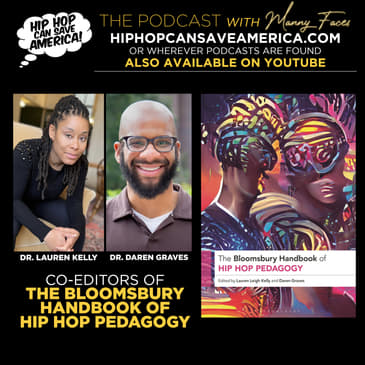
In this enlightening episode of "Hip Hop Can Save America," host Manny Faces dives deep into the transformative power of Hip Hop in education with distinguished guests Dr. Lauren Kelly and Dr. Daren Graves. Both scholars are co-editors of the groundbreaking "Bloomsbury Handbook of Hip Hop Pedagogy," aiming to establish authentic guidelines for the implementation of hip hop education in classrooms.
Key talking points include the importance of engaging young people through Hip Hop culture and the role of Hip Hop sensibilities in innovative research methodologies. As Dr. Graves explains, “Using Hip Hop sensibilities like rap, rupture, and mixing as a way to approach research can truly revolutionize academic methodologies.” Dr. Kelly adds, “We need to validate the work of doctoral students authentically entrenched in Hip Hop culture; it’s about questioning institutional indoctrination and creating spaces for authentic learning.” For those eager to rethink educational frameworks and make their classrooms more inclusive and connected to the culture, this episode is a must-watch!
The Bloomsbury Handbook of Hip Hop Pedagogy: https://www.bloomsbury.com/us/bloomsbury-handbook-of-hip-hop-pedagogy-9781350331815/
Teaching With Hip Hop in the 7-12 Grade Classroom: https://www.routledge.com/Teaching-with-Hip-Hop-in-the-7-12-Grade-Classroom-A-Guide-to-Supporting-Students-Critical-Development-Through-Popular-Texts/Kelly/p/book/9781032258010
HHYRA Conference: https://sites.google.com/view/hhyraconference/home
---
Hip-Hop Can Save America! with Manny Faces is a Manny Faces Media production, in association with The Center for Hip-Hop Advocacy.
Links and resources:
SHOW WEBSITE: https://www.hiphopcansaveamerica.com
ON YOUTUBE: https://www.hiphopcansaveamerica.com/watch
MANNY FACES: https://www.mannyfaces.com
NEWSLETTER (free!): https://mannyfaces.substack.com
SUPPORT QUALITY INDIE HIP HOP JOURNALISM: https://www.patreon.com/mannyfaces
Manny Faces Media (podcast production company): https://www.mannyfacesmedia.com
The Center for Hip-Hop Advocacy: https://www.hiphopadvocacy.org
SPONSORS / FRIENDS:
The Mixtape Museum: https://www.mixtapemuseum.org
Hip-Hop Hacks: https://www.hiphophacks.com
Hip-Hop Can Save America! is produced, written, edited, smacked, flipped, rubbed down, and distributed by Manny Faces.
Eternal thanks to Consulting Producer, Sommer McCoy.
[00:00:00] I am brother Cornel West and this is Hip-Hop Can Save America I'm going to talk about my free sub-stack newsletter at MannyFaces.substack.com that's filled with all kinds of stories of Hip-Hop innovation, inspiration and generally Hip-Hop news that
[00:00:42] isn't about dumb sh**. For everything Hip-Hop can save America, Hip-Hop can save America .com. For everything Manny Faces, MannyFaces.com. And if you find value in this work, you can support it. We'd love to have you aboard as a supporter at patreon.com slash Manny
[00:00:55] Faces. Now let's go. The thing about Hip-Hop today is it's smart. It's insightful. The way that they can communicate a complex message in a very short space is remarkable and a lot of these kids, they're
[00:01:15] not going to be reading the New York Times. That's not how they're getting their information. Peace and love to my friends. Thank you for stopping by Dr. Lauren Lee Kelly, Dr. Darren Graves, the co-editors of the Bloomsbury Handbook of Hip-Hop Pedagogy and Friends of Mine and
[00:01:54] we've worked together on a bunch of things and it's really great to see how we haven't been in the same place at the same time for a minute. So it's nice to see your faces. For sure.
[00:02:02] Thanks for stopping in. Obviously we want to talk about the book. The book has been, I mean, semi-recently released earlier this year, I guess, right? So it's still pretty hot off the presses as they say. I want to talk about the book and I want to talk
[00:02:14] about the idea of Hip-Hop Pedagogy for the uninitiated and what it means to put together this, you know, this pretty hefty handbook as it were. Nice, nice word because that's what it's called. So I'm able to use that word because y'all gave it to
[00:02:31] me. But that being said, please, I could, I know y'all, so it's like very friendly and informal but to those who might be watching or listening that don't, I could just read your bio. That's boring. If you would, please present yourself
[00:02:42] the way you like to be presented to the world. Dr. Darren Graves will start with you, sir. Hello. My name is Dr. Darren Graves. Most people know me as Darren or if you're really close, you might know me as D. Graves but that's me and I am a
[00:02:57] professor at Simmons University and lecturer at Harvard Graduate School Education. Oh, I've heard of that place. Dr. Kelly, Lauren, how are you? Great thanks. Lauren Kelly, associate professor at Rutgers University Graduate School of Education and I am a co-author, co-editor with D. Graves,
[00:03:18] which I've never called you that before but since that's, I guess, the intimate term for knowing you. I'm a start now. So, yeah, I'd like to take the opportunity to call you D. Graves too. So, D. Graves. Yes, thank you. I think, I'm glad we're that close.
[00:03:33] How long was the, well, for those who don't know, the Bloomsbury Handbook of Hip Hop Pedagogies, a compilation or, I don't know how would you, an anthology is that the correct term? I think a collection of... A collection. Let's go with collection.
[00:03:49] So, I would say collection or compilation because anthology, for me, is like these things already existed and you're sort of pulling together things that have already been in existence. But this is like all new and fresh.
[00:04:00] So each track in this book just came out, was not accessible before. And it's something that was specifically created for this collection. Overseeing this project and compiling the compilation, what was the overarching goal? What was this, what's this book intended to do?
[00:04:20] Yeah, I think we were trying to think about where Hip Hop Ed is at this moment and where Hip Hop is at this moment, you know, and it's in a precarious place because of its popularity. I'm trying to set some sort of guidelines, some principles,
[00:04:36] some North Stars for how Hip Hop Ed should be implemented, thought about, theorized, authentically moving forward. So that was, I think, the impetus for this project. Yeah, again, for the uninitiated, most people listening or watching, it's a pretty niche show. They're going to know what we're talking about.
[00:04:57] But the idea, the concept of Hip Hop education, Hip Hop pedagogy, again, for the uninitiated or for those who might be in different fields that don't understand the depth and breadth of Hip Hop as an educational vehicle.
[00:05:11] I don't want to say tool sounds kind of, you know, clumsy, but like a vehicle or a, you know, a pedagogy. What does that look like just on a very layman's lay person's level? And then how deep and complex does it get
[00:05:25] that y'all had to put together a whole some hundred page handbook to get it right? Super complex. So Hip Hop pedagogy is going to look different in different classrooms, right, based on where you are in the world, what subject area you're teaching, the age that you're teaching,
[00:05:41] the language, like all the things that go into who a person is, the community that they're in, what makes up one's identity is going to have an influence on how and why you're working with Hip Hop in the classroom.
[00:05:53] But essentially, it's the idea that Hip Hop is a powerful force in the world. And in particular, it's a powerful force in young people's lives. And so just like any other powerful force, it should be included in classrooms.
[00:06:06] It should be interrogated and investigated in classrooms with students, right? Not sort of for them or on behalf of them and not to criminalize the genre and not to challenge it in ways that distance students from. And so the idea of Hip Hop pedagogy,
[00:06:23] which we just saw within the field of hip hop education is how do we interact with hip hop as a form of not just music, but also language and culture and identity, a lens for understanding and being in the world.
[00:06:37] How do we bring that into classroom spaces in order to engage with young people in ways that are healthy for them? And we said, help them to understand themselves and understand the world and to carve out a path for them in the world, right?
[00:06:48] Especially because schools are sort of historically places where we tell students who and how to be in order to seek success. And so Hip Hop pedagogy forces us to think about what that really means, right? What is it to be successful as a young person in the world?
[00:07:02] So to try to chart out their path in it. And degrade, feel free to. Yeah, that's a great. Yeah, that's a great breakdown. You know, I heard part of the question was about then the process of trying to make this happen, right?
[00:07:17] Yeah, knowing knowing this as a foundation, I guess, you know, this is what we're trying to do is hip hop educate, you know, education surveyors, you know, how complicated does that get, you know, to try to rein all of that in
[00:07:31] because it's it's both, you know, wide and expansive, but also it has some tenants, right? So how do you juggle that? Right. And I think there's this tension and to me, the hip hop and education are like are together. They say they're not right. But there is there's
[00:07:48] is a tension sometimes between hip hop and schooling, right? Because schooling is institutionalized, right? And so and schooling is about conformity often and hip hop is like, I don't know about the opposite of that. Right. And and so one of the real tensions of putting this together
[00:08:08] was like we're putting this together for the Academy, right? In some ways or through the Academy, but we're not. But we don't we under this verse. And we didn't want this to be for the Academy because the Academy don't Academy is not really about that life writ large.
[00:08:22] There's a few of us, but like not really, right? And so we were thinking about audience that was larger than the Academy for one. That's important. We were also thinking about voices that were going to be included in this volume
[00:08:34] that we're not going to be stodgy, you know, professors from the ivory tower, too. Right. So we were trying to be really expansive about where we saw expertise lying. And so I think we were really intentional about thinking about the diversity of voices
[00:08:50] we were bringing to the to the volume in terms of like their clinical professional background or their and or their connection to the culture. And and we talked about it in the law. And, you know, we can say more about this, but in the introduction, talked about ways
[00:09:05] that we were trying to reach out to some folks who are like real pioneering contributors to the culture to be part of this, because that was kind of our ethos. And we ran into dilemmas because like, you know,
[00:09:17] we didn't have no money to pay people to do this. This is like an act. This is like an Academy thing. This is where the Academy comes in, right? Right. And so people were right. Rightfully asking us about like, how am I going to compensate for this?
[00:09:28] And we were interesting, you know, and we were like, and we, which we did not think was an unfair question. Sure. And we did not have the right answer for them. And so that created, you know, dilemmas. We are very happy with.
[00:09:43] We love the family that we created putting this put together. And we definitely had intentions of having other people in that family as well. But we couldn't. We just couldn't make it work in that way. That's interesting in that that in and of itself opens up
[00:09:59] like a different dialogue, a different dilemma in the pursuit of hip hop as a, you know, as a real thing. You know, getting folks to finance these things, getting folks to fund these things, getting research grants, getting people to, I don't know, give to someone's Patriot account
[00:10:16] so they could continue doing one of the most enlightening hip hop podcast live stream shows in the world. I just know hypothetically just saying that's for you listeners and watchers. But that that presents a problem in of itself.
[00:10:27] So I'm glad that you were able to still assemble this, you know, Avengers team of brilliant minds to put this stuff together. What are some of the, I guess, I mean, explain the entire book in five minutes. But, you know, what are some of the the,
[00:10:43] I guess, you know, key takeaways that someone might get for you say it's not for the academy. I'm sure that folks that are in this field are going to find it super valuable. And then like who else might find value in it?
[00:10:53] And I think we get summed that up by some of the takeaways that one might get from perusing this gargantuan tome. I don't know how big it is. I'm just saying you haven't gotten you haven't you haven't seen the cliff most version.
[00:11:05] You haven't gotten the cliff most version yet. No, I what I what I have is is none of that. I tried to buy a book, but not enough people pay my Patriot account. So I can afford the book. No, I'm playing no money. Lord, go.
[00:11:21] I was going to save this for after because this is like a personal chat, but we have your book. It's here. I just I am not in Atlanta, but no, you are not. I guess I could. I appreciate that.
[00:11:32] I look forward to the way I'm so I see you. No, I'll be. That's all good. Well, you're also you've been kind of everywhere. So it's hard to track you down as well. Up there, fellowing at Harvard and things like that
[00:11:46] that you conveniently left out of your original introduction. But I won't discount that being said. So some key takeaways from the book that, you know, academics and others and who might those others be? Yeah, forgive that. I had a lot of your honor roll.
[00:12:01] I'm going to leave a lot of things out today. So this book, as Jared explained, is really audience wise. We didn't want it to be narrow at all. So this is not which is a tough thing. Like we can do a whole thing about the book proposal world
[00:12:14] when they ask you audience, right? And you're supposed to have this like one singular audience. And it's like we don't hip hop doesn't have a singular audience, first of all. Nor does this book. And so we wrote it for teachers. We wrote it for professors.
[00:12:27] We wrote it for grad students. We wrote it, put it together. We compiled it, go edit it for high school students or community members, for librarians, for parents. We really want it to be something that is accessible, linguistically accessible, right? Content wise, accessible, but also something that's useful,
[00:12:47] right? Not a book for the sake of having a book, but something that can be of use in the world. And so it covers just sort of like a basic intro to the history of hip hop. It's not all of it, right?
[00:12:59] Because we know the history of hip hop is so layered and so in depth. But we wanted someone who maybe knows nothing about this, but maybe they have a student who's interested or someone's on leave and they got to teach them about class and they're like, oh, shoot,
[00:13:12] I need I need to learn something. So sort of like a crash course into here, sort of some basic understanding of this history and culture. And then also sort of a brief overview of the history and culture of hip hop education, right?
[00:13:23] Which is not synonymous with hip hop. It's sort of its own thing. And then we also sort of the sections work through the history of the culture, what it is culturally and historically. And then what it means as a form of theory, right?
[00:13:37] Which is not often talked about, right? Hip hop is seen as music, right? It's seen as this cool thing that maybe can get students more engaged in the classroom or like it's so much more than that. It's actually a way of seeing the world, right?
[00:13:48] A way of thinking. And then we talk about research in the field of hip hop and education and of course teaching. So we include voices of teachers, of students, of undergrad students, folks who are just sort of emerging from undergrad right now
[00:14:02] who are emerging scholars in this field. So we're really including voices to make sure that we're not sort of the old heads thing like this is what hip hop is and isn't, right? That we're not the gatekeepers of this culture
[00:14:14] and we're really inviting everyone to participate in co-constructing this dialogue around what hip hop pedagogy is and what it can do in the world. Yeah, that's dope. What I'm always particularly interested in research, right? Because I think research shows the receipts to a lot of things,
[00:14:33] you know what I mean? And it's like when we're when I'm speaking to folks who are outside less familiar with the culture and I'm espousing all these ideals of hip hop education and hip hop being really great for all the people.
[00:14:46] You know, my dad being a distinguished professor of sociology would have been like, well, where's the where's the data? Right. And I'm like, OK, we actually have some of that now. Can you give me an idea a little bit about the research section
[00:14:57] and what some of the things you highlighted in the research, I guess, section of the book or some of the ideas that are floating around that are research driven? Yeah, I think I'm not sure this is exactly the answer to your question
[00:15:09] because I think we were thinking the research section was really thinking about like how one might engage in engaged in doing research. Even better. Yeah, OK. Using hip hop sensibilities. And so one of my favorite parts was think it was a doctor.
[00:15:32] Emory Petra has this wonderful chapter on thinking about hip hop sensibilities like rap, like rupture, mixing. There's some other ones that I'm not that I'm thinking off the top of my head because I'm just doing a bad job, but using those sensibilities
[00:15:51] yeah as ways to think about how to do research methodology. So he was talking about ways in which if you can, you know, because oftentimes, for example, folks use multiple theories, right? You know, as they're doing their research or analysis
[00:16:08] and but how they use it is sort of like they're sort of sort of not using it like entire theories together. They're sort of they might use an entire theory over here, but then a little bit in part of it from over there.
[00:16:22] Right. And so he's sort of talking about, you know, using using like the mixer, right, as a metaphor for like how you're modulating which theories you're bringing in here, you know, and how that might fade away when you're looking at something else over here.
[00:16:35] And so I just thought it was a really brilliant way and I think really innovative way of both thinking about hip hop beyond its core elements or its tenets, right? And then moving into the realm of thinking
[00:16:48] about the sensibilities of hip hop, which I think are to me like more super fascinating in ways that I think people are actually like probably like being and living hip hop more than they are sort of more than through, you know, enacting specific tenets or right. Right. Right.
[00:17:08] So and then but then the notion of then how you can then bring that into the realm of this like, you know, this sort of, you know, sort of like stodgy field of like research and research methodology, like how do you even do the research or conceptualize it?
[00:17:23] Right. Yeah. Really fast. It was like a really fascinating. And then there's much more in there, but that's just what came to me off the top of the head. And Dr. Tashia Glazya's contribution, sort of spinning off
[00:17:34] of that talks about what it is to be a doctoral student doing research that's so sort of authentically entrenched in hip hop culture and community and education and having all sort of the stodgy faculty members saying like this isn't legitimate, right? This isn't real.
[00:17:50] This isn't there isn't a framework for that, right? So having to do exactly what Darren just described, which is sort of pulling together this theoretical framework that is still authentically hip hop and that also is in dialogue with existing theories, sort of within
[00:18:05] the field. And so that and that's why to go back to the original question about like why this book, because we recognize that folks are doing work in this field who are doing research are going to hit those roadblocks, right?
[00:18:15] And those gatekeepers that are like, this isn't legitimate. This isn't a thing. There isn't a history of it. And so like, well, if they need to have an academic text to sort of base this on, even if we don't believe
[00:18:25] that that's what people should need, but we also understand that this is sort of the reality of the world that we're in and sort of gives them that thing that they could say like, you know, there's a whole Loomsbury
[00:18:34] handbook of hip hop pedagogy saying that this is a thing and that this is legitimate from scholars who are doing this incredible work. And so yeah, it's a really dope session too. Right. That's why I'm in this case. I wouldn't have the data to show my dad.
[00:18:47] I'd have a whole book about here. Read this to shut up and let me know later what you think. My dad's not around now by studying these arguments with him. So that is interesting. And it also conjures up the idea that, you know, I
[00:18:59] often preach about where, you know, everybody who wanted to try to be a rapper at one point and then didn't go and become a successful rapper tends to be a better public speaker. Like they tend to have better communication skills or better social and emotional intelligence
[00:19:14] because they've dealt with, you know, and in what you're telling me about the research, it's like this is a way to better research hip hop. But then using hip hop as a way to research is a better way to research. Facts. It's just, you know what I mean?
[00:19:27] It's like a new way of being able to research. And what do we see so often in the in the research world or in the in the academic world or, you know, all these things is you've had this, you know, one way of doing things or
[00:19:38] this, you know, centralized way of doing this Eurocentric or, you know, old fashioned or whatever way of looking at things. And so you miss so much, you know, you miss so much by not looking at it through that lens, through the sensibilities of
[00:19:50] multiculturalism or, you know, or in this case, hip hop, which is that and more. And now you've developed a new thing that hip hop like both had something to do with and also has nothing to do with. That makes sense. I think that's what hip hop is, right?
[00:20:05] Yeah, facts. I think that's what hip hop is, right? It's it's it's it's it's sort of putting itself in a place where it didn't sort of belong at the first place. And also simultaneously being like, this is ours. Like what are you talking about? This is like, right?
[00:20:20] As we often, you know, Grandmaster Kaz quote from the Art of Rap, the documentary where he says hip hop didn't invent anything, but hip hop reinvented everything. You know, it's in the intro to this part of the thing. Hold the words right out of my brain.
[00:20:36] So well, you know, slightly less genius mind and genius minds sometimes think alike. So yes, it's very dope. It's it's a it's a beautiful thing that you don't even know about if you don't like if you don't know, you don't know. And that's why it is
[00:20:52] important that books like this exist, even though they, you know, like the book we don't we wish we didn't have to write because we wish everyone knew this already and didn't have to give you the two in a book. Yeah, I get it.
[00:21:02] Or that it or that it didn't have to be a book right for it to and we can talk a little about that or they didn't have to be a book for it to talk about it. They talk about it. So tell me what that that that
[00:21:12] and that invokes. Man, well listen, so like real talk like, you know, we I don't know how to say this politely, but like the way that the book is currently back to the Academy, right? So the Academy has got this the Academy is Academy right. Right. Right.
[00:21:29] And so the book as currently priced is just not accessible and we're not and we and all we would like it to which is I'll just put it as then we'd like it to be more accessible in the means and it will be when we start
[00:21:41] to move in the Academy academies will it'll be a time frame or something off cover edition and it'll be more accessible. So there's that. Right. In the meantime, as you know, man, we've been working on a podcast, a companion podcast to the book for a variety of reasons,
[00:22:03] if not one just to like make it I don't know the learnings and the wisdom and the knowledge right, accessible to the people at the very least and that's that's part of the goal of the podcast is and also but I think also the model for the Academy.
[00:22:19] Here we go. We were just talking about reinventing right to model for the Academy possibilities for how how we can disseminate information through the Academy moving forward. So that's for us. One of the goals of this is yes, to have a podcast that as you know, man,
[00:22:38] as you've been working with on this is like just a super fun project. It's been a great opportunity to like connect with folks who are connected to the project and learn and but and but also for it to be like like an actual companion piece
[00:22:55] to the you know, the written book right that people can guess what like sites and find and treat as you know, literature, a text. Right. That you know, you know, that is rigorous and that has things to be learned from. And so so that's that's that's that's
[00:23:14] that and I'm sure you want to have to say something else about this. But yeah, we were really that's where our energies are really being put right now. We want to figure out how to make sure that people can actually access this knowledge. Yeah.
[00:23:26] I love thinking about the ways that people take in knowledge. Right. So anyway, yeah. And something that I really love about the podcast project as a companion to this piece and the book itself, going back to sort of how it disrupts the Academy is that
[00:23:41] what they also ask for, you know, when you're a grad student, even as an academic is that everything is supposed to somehow be like really neat and perfect. Right. Like every question has an answer and that you can answer it. And I think Hip Hop is a reminder
[00:23:54] that like it's messy. Right. Like nothing ever has a direct answer. And I think it really came through folks listen to the podcast. Like here's all these brilliant minds who do this work, who know their fields, who are experts. And we don't all agree on these things.
[00:24:08] Right. Like we don't all have a shared definition of what Hip Hop is and isn't, right? Or who authentically is a part of the culture. And I think that one does. Yeah. No one does. And I think it's such a perfect example
[00:24:20] of like the reality of the Academy says, right, that like you have this research question and then you collect data and you answer the question and you publish it. And now we all know the answer. And like none of that is real, right? It's a response to
[00:24:33] a question. And I think what we see in the book and we really try to tease out these tensions in this book and show that like we're all experts and we're all questioning all the time, right? And we're all students all the time.
[00:24:43] And and no one really knows and we're going to lean into that messiness. And there's a lot of beauty and there's a lot of wisdom that comes from the unknowing and from having that discussion. And I think there's so few places in the Academy
[00:24:56] where you get to do that, right? Where you get to authentically say like, there's things we don't know. But like, let's talk about it. Like you're not allowed to show the behind the scenes, like questioning of things. And I think Hip Hop reminds us that we should write.
[00:25:08] How can you learn if there aren't questions floating around all the time? Yeah, I appreciate it. And one of the one of the tensions that I think showed up in that regard is the notion of that the most of the many of the
[00:25:20] educators who are in Hip Hop at are like in a different generation than the in the Hip Hop generation than their students, right? And so one of the key tensions that we we kind of address in that regard is like, how do you
[00:25:33] you know, because we've had young even young folks even at the last at our last AERA, you know, big research meeting, you know, Hip Hop and meeting we had young folks coming at us like this doesn't feel like the hip hop that I listen to it.
[00:25:47] This doesn't feel like you're representing the culture in the way that I right experience it, which I think which by the way I love right. I love it. Like I welcome this right. This is like and I have many notes. I have like teenage daughter.
[00:26:00] So I live this life. I my whole life is like people and I'm telling you. Right. That's all good. But but yeah, but we we explore that tension head on in the book to this notion that like no matter you know, we're talking we're situated in a
[00:26:16] specific moment, but like regardless of the moment, there's going to be moments where like it's going to be different generations of folks like trying to like interface each other around the culture and like exploring the tensions of what it means and not and me not trying to
[00:26:30] end, you know, my daughters have fully made this 100 percent possible. Like that for me not to be the get off my lawn hip hop, you know, fan, you know, like fan, right? Like oh, I had the original stuff. This is all you know, what is this? Forget it.
[00:26:43] Right. Yeah. We explore that tension specifically because that that that's that that dynamic is going to reproduce itself over and over just in different ways. Yeah. The generations. It's also funny when it works the other way around. I was in a car and I'm playing
[00:26:56] like Sirius XM and it's like the groove which is all like 70s soul and R.B. And an all night long comes on, right? So all night long is rocking and baby girl faces goes, that's where that's from. And I'm like, what's talking about?
[00:27:09] She goes, it's a firm. It's a mattress firm commercial like the guy they use it in a mattress for a company. So it's really yeah. And so she and then she calls it up on YouTube and shows it to me. And I'm like, so it's really fun
[00:27:18] when you're open to like both when that goes back and forth. You jumped into it and it was kind of where I was going and Lauren, you've done that. I mean your work, which I cite all the time either in writing or just telling stories,
[00:27:30] you know, the work you've done when you've examined things from a younger hip hop perspective and going so far as to say, oh, I thought I was doing it right. But then I really had to talk to the kids and find out like, oh, here's how maybe
[00:27:43] I shouldn't really be doing it in terms of interrogating young people and how they see the world using hip hop as our common denominator. But, you know, having to make sure that we do what Darren says, like not be the old heads. So in both of y'all,
[00:27:58] but just Lauren, if you want in your experience now teaching teachers how to teach, right? Or working with teachers who are coming up in the game, young researchers, what are you seeing like trend wise? Like are they bringing up things that even y'all didn't even
[00:28:14] think about when you're trying to think about all the things to think about? What do you else see in the next generation? It's first of all, a lot of it depends on the person and the moment. But what I'm finding and what I've been in some ways
[00:28:29] disheartened by, but also invigorated by is that what I'm seeing with teachers, students who are training to be teachers and also students who are students and trained to be students is how insidious these structures are in schools. Right? So you would think, right, because young people are young
[00:28:51] people because they're hip hop heads, that they sort of have this anti institutional attitude, right? That they have this like I'm going to do it my own way, right? And I'm realizing it's actually really rare, right? So like the Stevie Johnson's of the world, right? The 80
[00:29:04] Carson's of the world, those folks that say I'm going to enter these institutions and do it my way. It's rare and it's more likely that people are sort of indoctrinated or trained to do things in a particular way. And so even in the process
[00:29:17] of putting this book together, we're sort of going back and forth with some folks, even some of the younger folks about like you don't have to do it like that, right? Like just because your English teachers said that you have to do it like that
[00:29:27] doesn't actually mean you have to. And so there's been a lot of unlearning that has to happen in a teacher education classroom with young folks who are sort of in this intergenerational hip hop community world where they're kind of after so many years of being indoctrinated in K-12
[00:29:43] schooling and in some ways in university classrooms, they feel like they have to write the way that their professors write, right? They feel like they have to write the way that people in books write, right? They have to sound like an academic. And so there's actually been
[00:29:56] a lot of hard conversations we've had to have over like you'll be you. And they're like my entire life I've been told that I can't. And now you want to turn around and tell me to write like I don't even know who that is anymore.
[00:30:06] And so that's really what I'm finding more than anything else is that there's a lot of unlearning that has to happen. We have to reinforce the idea that these institutions don't also have the right answer just because they've existed and just because they have names like Harvard,
[00:30:19] it doesn't mean that they are right, right? That they are correct in what they do, that we have to do what they say that we have to fit in to those boxes. And it's really hard because it's worked for people, right? And so that's what I'm finding
[00:30:32] is trying to find ways to obviously still make sure that people feel like they can be successful, right? It's like burn it all down and like hopefully you'll find a job and be able to live your life but also to think about
[00:30:43] one of the ways you can push against and reshape these structures and institutions as opposed to just fitting into them, right? Because then everyone can be struggling all the time. And so we're opening doors if we are sort of carving out those spaces
[00:30:55] and not just kind of like fitting into them. Yeah, yeah. I'm sorry if that was sad. Take a slightly different to know it's important. That's real. I have a follow up but Darren, go ahead. No, no, you go ahead. Go ahead. No, no, no, no, no, no, no,
[00:31:09] because you might like lend insight. Go ahead. I'm not going to forget it. Go. Yeah, no, I was just going to say I'm sort of invigorated by what I'm seeing with the young folks today. Lauren will be first to tell you that like, you know, like,
[00:31:22] I'm, you know, you know, the hip hop that I'm listening to today is like a lot of like UK grime kind of scene. Yeah. And I'm really sort of fascinated with some of the Afro beat and I'm a piano stuff that's going on over
[00:31:41] on the African kind of it's to me, I'm just so fascinated with how folks particularly outside the U.S. are remixing and reread remixing. Right, because there's so many layers to like the me like but like how they're re-re-mixing hip hop. What it's to me.
[00:32:03] Or I could also say I'm just fascinated with just like England in general, especially black folks, England. And so to me, it's just a nice, it's a win, even if it's through the lens of like pop, pop, pop, shout, shout, shout. Like, right still I'm getting senses of
[00:32:18] like what's life like over there? OK, what kind of issues are folks, you know, young folks dealing with these days. Right? I'm interested in the ways that folks on the continent are moving their bodies, right? And creating like, you know, movements around, you know,
[00:32:33] whether it's in Ghana or in South Africa, right? Or Nigeria. And so, and there's a part of me that feels like my parents did, right? There's a part, I'm trying to resist to being the way my parents were, which was like, my parents heard the music
[00:32:48] I was listening to, they were like, what is this? I'm not, like, I don't like the language. I don't like the content. It's not like the stuff I listen to. This is a problem. I'm trying to fully not be that person. Right? Like really, and trying really,
[00:33:02] because my response to them was, oh, it wasn't just about the content. It was a vibe, it was a feeling. Or it was like, you know, representing a context that makes sense to me or whatever, right? And so I'm trying to take that lens
[00:33:16] as I listen to the music of today, whether it's from US or beyond. And really, and it's in it to me, it's like kind of invigorating, right? It's invigorating because I'm seeing the world both, yes. Through the lens of my old ass person,
[00:33:30] it was just like, ah, like, y'all need to do things, you know, my way. But also like, it's inspiring a sense of hope, freedom dreaming, how about this, freedom dreaming. And this is what gets to Lauren was talking about.
[00:33:40] The atom is not built for freedom dreaming at all. Right. Hip-hop is, and so here we go, like now. So now we gotta like figure out when we bring these things together, like how can we make hip-hop and the space, A space,
[00:33:54] not maybe not D space, but at least A space for actual freedom dreaming in the academy. Okay? Without that, like the academy is not doing it for me. It's my, I get paid by them 100%, but it's just not doing it for me. There's nothing from the academy
[00:34:07] that's moving me right now at all, at all. Sorry. Besides, Glimmer's very hip-hop, handbook of hip-hop, I gotta go. Besides that. Right, they did good. They done de-graves good. So now this is gonna be like a philosophical thing. I don't wanna get too deep in the conversational weeds.
[00:34:25] We have a podcast for that, but it brings me to something that I'm now really starting to think about. And I'm sure y'all thought, we've all thought about it. Especially now because as wonderful as the world is, we're in America and I don't know if you know this,
[00:34:42] but America doesn't really like changing stuff, especially if it benefits people that don't look like me. So what happens is they resist all of this and now you're seeing a lot of the, I guess the progress that's been made by folks like progressive educators.
[00:35:02] I'm just saying progressive in general. I'm not even getting to the abolitionist type, Southside Dr. Bettina Love and people who advocate for abolitionist theories in education. But just folks have been like, no, we could do it a little different. We could sit in a circle.
[00:35:15] Like we could bring a DEI aspect even if it's not official. Like they've done this work for years and it's gotten, I think it's helped. It's gotten, I mean, depending on you would ask there's an entire movement of people
[00:35:28] who'd say that it's the worst thing in the world. That all being said, if we believe that it's a good thing, if we believe progressive educational practices are good, if we believe that hip hop is the most progressive educational thing that we can work into the mix.
[00:35:41] And if we believe all those things, they're trying to stop all that. They were letting it go for a while. You could do it. You could be AD Carson. You could be Dr. Kelly. You could be Dr. Gray.
[00:35:50] And be in the spot and kind of maintain your authenticity to both your cultures, whether it's a black American culture, hip hop, the Venn diagram where they live together. You could do that. But now no, no, they're gonna stop all that.
[00:36:02] They're gonna stop all, especially in some states. The bigger question is how much can we rely on the academy for being a place where we can make those changes within the academy and how are we going to do it outside of the academy
[00:36:18] if that is less and less likely moving forward? That makes sense. I mean, I'm trying to say like, like where's the like, we don't have a grassroots movement in hip hop like we used to, we kind of do, but we don't. It's not, how does that happen?
[00:36:32] How do we make it work? Lord, do you have something for this? First of all, you can see for everyone's reaction, we don't rely on the academy for anything. And that's a no, no, I get it. Like we, that can't be our end all be all right.
[00:36:49] We can't make moves based on if the academy is going to accept it or can I keep my job if I do that? Right. If I publish this book, is this gonna be the last thing I ever get to publish? That's what I'm getting at.
[00:37:01] So like, what else can we do? Yeah, yeah. The hope that I find, and the reason I invest so much time and effort into the work that I do with young folks who as I get older are becoming like, like they're younger, right?
[00:37:13] We used to call them like the youth and now we're like the younger than us people because they are also now like almost in their mid 20s. But I invest that time because I, A, I don't necessarily think that I have all the answers,
[00:37:23] or that we have all the answers. We always have to be in dialogue with young people who just have a different perspective on the world. I grew up in the world in a different way than we did, right? Who grew up with things like social media
[00:37:34] and we did not. So they're just gonna have ideas and perspectives that we don't, but also through that dialogue and through the intergenerationality, we're able to sort of show them some examples of things. So I introduce them, like we bring them to spaces
[00:37:47] like Simmons, the teachers college, right? To Harvard, to Rutgers so that they can understand these structures. They can understand how they operate and then they can create their own structures, right? They could sort of decide for themselves which ones they want to adopt or fit into
[00:38:00] or adapt or just completely tear apart. And so for me, it's really long-term work. I don't think any of this is overnight. It's like just tomorrow we suddenly have this, you know, this grassroots movement that's doing that. But I think over time we're building in ways
[00:38:17] that they can start to build their own institutions. They can start to build their own sort of spaces and structures for doing this work authentically. And I think they also cannot do that alone, right? In some ways it's financially but in other resources, right?
[00:38:30] So I think again that collaboration allows for young people to lean on us, to ask questions, right? To have us as a resource and also to create their own things. And so in my ideal world, you know, the academy is not like the central piece of this, right?
[00:38:45] It is one resource and one tool in this larger work. Yeah. Yeah, that's what I did before you guys. I just want to shout out, obviously you have the receipts for this with the work with the HHYRA, the Hip Hop Youth Research and Activism Conference
[00:39:01] and Initiative, it's not just a conference. It's you know, not just a one, you know, and then you're done. The whole thing you've done with that, I do encourage folks who say, oh my God, yes, I'm a teacher or a community organizer
[00:39:11] or a nonprofit leader, you know, to say, I love what you're talking about. What does that look like in practice? It looks like that in practice. It looks like the Hip Hop Youth Research and Activism Conference and Initiative that you spearhead and so people should look into that
[00:39:24] as a way to model how we, it's been done brilliantly, how you bring up younger folk with this mentality and then with the full intent of, hey, we are handing you the torch before you even want it, but you're gonna take this torch,
[00:39:40] you're gonna, you know, and move it forward and we'll help you guide you as much as we can. But you know, take it and go because you're ingenuity, I mean, this has been Hip Hop's thing also, the ingenuity of the youth is unsurpassed
[00:39:53] and we can't even fathom it. And that's why young people are always at the center of innovation. So it's just a brilliant way to do it. So Darren, I'm sorry, I just wanted to give props and let people know that this is a thing that exists.
[00:40:02] It's not just, you said it's an your ideal world. Yeah, in an ideal world, it's all over the place or it's bigger and we all do it, but you have the model and I just wanna give props. Darren, go ahead. Come on now, exactly, thank you.
[00:40:12] And so thank you for shouting it out and leaving to Dr. Loren Kelly to put it in the youth's hands, right? For, you know, issues, for senses of hope and I'm with that too. I also think the subtext of the, this is where the sensibilities of Hip Hop
[00:40:28] is also important, right? So this question is like, there's a context in which everybody's like trying to tear this down and so how do we do this? Like, so that's, I don't know. That's just like the context about Hip Hop was born, right?
[00:40:38] And so like the context of Hip Hop was born is like literally burning the city around us and then yet here we still are, right? And so to me, some of this is like, we have to hold on to that sensibility of like
[00:40:51] how, what was Hip Hop born under? Like what was it, you know, what were they trying to do? To me, the academy, if we're gonna use like, as a metaphor, the academy to me is like the light pole, right? It's the light pole that we, that we stay,
[00:41:03] you still, that you steal the election. So that then you can do the party, right? If you need it, you need it for something, but it's not the thing, right? Right, right. And so- You could do the party in the rec room, but if you wanted it outside,
[00:41:17] we found a way to do it. Right, and so- Got it. And so to me, it's like, to me, it's taking the sensibility of the subversiveness of Hip Hop, right? The subversions of the culture, right? That we're in spaces that we're not invited in.
[00:41:31] But we gotta find ways to do the thing when even when we're being surveilled, right? Even when we're being surveilled, we still gotta figure out how to do this, right? And do it, right? And so we gotta take those same sensibilities
[00:41:44] in terms of how we position the work that we do in the academy. Like where do our courses live? How do we, you know, like, maybe we can't, maybe there are things that we can't say like in the title of the course, but that, but that,
[00:41:59] but that we, but the title of the course still draws the people who wanna do the right work, right? Right. And then we do the work we gotta do in the course, right? And classrooms are always spaces that are sort of simultaneously somewhat surveilled,
[00:42:12] but also simultaneously like these islands where you can do your thing. And so hip hop ed is part of a larger educational movement that's rooted particularly, I think not solely, but particularly in black education movement, which is as a whole history of doing the right thing.
[00:42:33] So, you know, under the cover of darkness because it wasn't allowed and we're gonna do it anyway. And so we come from a legacy of educators of many different races who had to fight against systems that said, you know, that, you know, your morals are wrong, right?
[00:42:51] Even though we know that they're right. And we figure out ways to get it done. And I think HHYRA, by the way, is a perfect example of what that can look like, right? You know, it's ways in which, you know, you can, you know,
[00:43:06] garner the resources of institutions who wanna do good work, who may not necessarily be like, I wanna create a hip hop ed conference for kids and maybe that's not what they're thinking. But guess what? Dr. Lauren Kelly has figured out a way
[00:43:20] to thread the needle of making the folks who are the gatekeepers for the resources, feel like they're doing their mission. And guess what? Lauren Kelly is doing her thing with these young folks, right? On the side, right? Right, right in front and center.
[00:43:38] And so I think we just gotta take, we have to embrace that, yes, we're in a moment where people are always fighting against us, so be it. That's not ever, that's not really ever... Not been the case. Right, right. Let's go, right?
[00:43:52] And let's just live hip hop in that way. That is powerful and it's inspiring. So thank you both for both of those sentiments that that's what I wanted to know. I think that, you know, all these quotes that keep coming around where Tupac said, you know,
[00:44:08] I may not be the one that changes the world, but I'm gonna be the one to inspire the mind of the one who's gonna change the world. You know, again, being in the academy, being in the positions y'all are in is not unenviable.
[00:44:19] It's a position that you can make things happen. You could put things into the record. You can, and then you have those opportunities, like you said, Darren, either, you know, sneak the medicine in with the candy, you know, and it's actually not a good phrase
[00:44:32] used when we're talking about young people. Or anybody for that matter now, I think that's kind of been, you know what I mean though? And you know, I'm a certain age, so I still have these colloquialisms that we still should. Anyway, you know, I love it.
[00:44:53] But you can get that done, you know, in that way and you can also then inspire the movements and initiatives that can take it out of the academy and do it in different places. I mean, we still see even with the recent conference,
[00:45:06] you know, Lauren that I attended and, you know, I've been very proud to be involved in the initiative and be a mentor and help out where I can here and there. The younger people that were once sort of, you know, the mentees, you know,
[00:45:18] for the most part kind of ran this conference. Now they still leaned on academic, you know, institutions for assistance, but there's no reason that that can't happen next year in a community center or in a non-pro, you know, with the Urban League
[00:45:30] or with, you know, some other organization. The blueprint is there. The academy gave you the seeds, but you can go plant that in any field that you want. So it's just, it really is just testament to what Yalla's saying. And I just wanna encourage other folks
[00:45:43] who might get discouraged. I mean, we talk all the time, our teachers, you know, or feel like they gotta leave because they're being constricted, especially more and more as, you know, the education system gets turned back, I don't know, about a hundred years or so,
[00:45:57] give or take, but that there's still, you can still make a difference and that it doesn't always have to be end all be all in the walls of those towers. So, you know, I appreciate that. That also helps me, you know, stay, you know,
[00:46:10] stay as Dr. Chris Emden who was on the show a couple, about a week ago said, stay low and keep firing. And I mean, he likes to say often. So I appreciate that sentiment. What else as we wrap up, do you need, oh go ahead Lauren.
[00:46:24] Just a quick shout out to many faces who was certainly, you said attended, you were the MVP of the 2024 HHYRA conference. And while I was not there, Darren and I were in Philly doing a thing. I just, I heard that the day would not have happened.
[00:46:42] Were you not there? Your genius mind just figuring things out with the technology and with, you know, as Darren was saying, just trying to like rig something when you were not given the tool for it to work. So thank you. Oh yeah, it was very hip hop.
[00:46:56] It was super hip hop. I appreciate that. It was super hip hop. I appreciate the appreciation. It would have gone on. It just would have sounded different, let's just say. But it was good to be in space. And again, that's the thing.
[00:47:09] We, you know, and I told him what I did and how we did it. And that's like each one teach one, which is at the center of all of this stuff. So thank you for that recognition. I did what I could. And that being said, so again,
[00:47:21] we could talk all day, we could talk all podcasts. So there will be a companion podcast, maybe dribs and drabs as we get it out. So be on the lookout for that if you want to learn more about the book, if you don't have the book,
[00:47:34] or if you just want to, if you have the book, you want to hear some of the, you know, additional conversations that were much more conversational than even the loose, informal, not informal, but like not totally academic writing of the book.
[00:47:46] We got down and funky in the after party. So look out for that. Other than that, what else do you want folks to know about the book in particular? And then the stuff you're working on right now, just to kind of, you know,
[00:48:01] big up yourselves for a second. I just want to say like another bit, another cool part about the book was that, you know, it's an international, we wanted to consider an international audience. Yeah. And so I think as editors, you know, we, Lauren and I struggled a lot
[00:48:16] or because we're not, we do not want to, we do not see us ourselves as like the gatekeepers of language and like, you know, we talked about this, you know, academic writing or whatever, but we also had to think about when we were using colloquial language,
[00:48:29] which we fully welcome, right? Like putting the medicine in the candy. You got to make sure that you got to go ahead. Maybe not that one, but you know what I mean? But the point is that we thought a lot about, you know, language and accessibility to folks
[00:48:44] who, you know, may not be from the U S. We also thought about this as a snapshot in time. We fully expect that this book will be fully a part of the canon, you know, 75 and 80 years from now. And so we were thinking about, you know,
[00:49:01] just trying to make sure that we were, it was written in a way that someone who was either not from the U S, maybe not from hip hop culture and not from this time would be able to access without turning it into like a total,
[00:49:16] like I don't know, I don't want to say censored version, but just kind of like stripped down not authentic version of people's voices and the representation of the culture. So that was one thing we thought a lot about as people were writing in and yeah, so. That's great.
[00:49:32] And just because you have my book and I haven't, don't have it in my, I've read parts of the book and it's like, that comes across. You know, again, I'm not, you know, traditional academic. I don't sit in, I haven't gone through those,
[00:49:45] you know, those procedures and processes of reading things. So I'm just a layman and sometimes now I'm an expert in this field, sure whatever, but I also can recognize that like, this is accessible for folks. And you said it early learn, you were like who could,
[00:49:57] who's the audience? Like right, they want you to have a persona. And I'm like, I don't know anyone who's like intellectually curious about this stuff. You know, that's a parent, you know, I, you know, and you know, I always say we want parents to know
[00:50:11] that hip hop pedagogy is a thing because your kid might not know it. Your teacher in school may not have it, but if you know it, then you could be a, you know, a soldier in the movement by going to your local,
[00:50:24] you know, board of ed and saying, hey, here's a whole last book. Like we're not doing this because this seems like it might make sense to try, you know, and then then it's not just teachers and you know, guys with super dope podcasts,
[00:50:37] you know, out here spreading the gospel. So I think that writing it in that way and making sure that you have those audiences in mind is the way to do it. So yeah, y'all. If I can add to that, just a quick plug for folks
[00:50:49] just to get this book in your library, wherever you are, wherever you're teaching, living, you can just reach out to your local library. It's actually a really easy process. Most of the websites just have a form for it. If they're a little more old school,
[00:51:01] you might have to make a phone call or send an email. But if you can get your library to pick up this book then folks can access it. And what's so beautiful about that, there's so many voices in this book that are first time, not first time authors,
[00:51:13] but I guess this is the first published piece. So the more hands we can get their work into is the more that people can hear their voices. They could be sighted. There's folks who've been really doing this work like Tashia Glacias, Vera Napudi.
[00:51:26] And so to just have more people hear from them and be able to cite them and amplify that voice is really important. So get in your library. We also, we love libraries. That's brilliant. And thank you. Yeah, yeah, thank you for that. That's a great idea.
[00:51:40] We should do a campaign just for that just to see that idea. I love it. What else is next? What else do I got going on? And then where can people catch up with y'all on this thing? They, it's like an electronic thing
[00:51:53] where people can connect with each other. I don't know much about it. Go ahead. The information superhighway. Oh yes, that's it. That's what it, yes, yes. I'll call it. Luckily we know some young people. When am I working? Okay, so I did just finish the Nassir Jones Fellowship
[00:52:06] at the Hip Hop Archive at Harvard University back at Rutgers University in the fall. I'll be teaching an introduction to Hip Hop Education course in the spring. So anyone who is within the consortium. So if you're out of school where you can take classes at Rutgers
[00:52:20] even though you're not a student you could take the class. And of course any Rutgers student that's open to everyone and really excited about it will be bringing guest speakers such as Manny Faces, Darren Graves, other amazing folks that look out for that.
[00:52:32] They haven't agreed to it yet but they will. Currently working on putting together a book project with some of the young leaders the younger leaders from the Hip Hop Youth Research Actives and Conference. So we'll be working on that this summer.
[00:52:46] Look out for that in the next, I don't know, year or so. And also currently working on a book on Hip Hop Education. So to further crystallize what we talked about earlier Manny about what does this work look like sort of tangibly in classrooms.
[00:53:01] It really gives you an intimate look at what does it look like to have conversations about rap specifically and about hip hop culture sort of more broadly with teenagers in classrooms. It's not neat. It is messy work and it's also really beautiful words. It's messy. It's super messy
[00:53:18] and there's a beauty in that tension. And so look out for that soon coming from Teachers College. I love it. Let me also remind people in my background that if you, while you're waiting for that teaching with Hip Hop in the seven to 12 grade classroom
[00:53:33] a guide to supporting students critical development through popular texts that's similar what you're talking about. I'm sure you'll get deeper into it but this is your current book that's out and about and I have it here at least gently and prominently. So if you don't want to wait
[00:53:48] you're like, oh my God, I got to read more of these words. That's the place to do it. Darren, which I would learn and then online, you know what's your preferred social? At DJ Duchess with three S's on all the things except LinkedIn
[00:54:03] because I refuse just those invitations. They make me not want to be a part of it. But yeah, at DJ Duchess with three S's you can catch me there. DJ Duchess and D Graves in the building D what you got coming up and how people find you.
[00:54:20] First of all, like I'm going to start working with Lauren just because like she's I'm always going to be second fiddle to this person who is an amazing human being who's always doing like all the things and amazing things. So just shout out to Lauren Kelly
[00:54:36] who by the way beyond all these like for get all the academic all these academic things. Like it's just like an actual human being first real talk, right? And connects with people as human being. Like when we have work meetings, we'll work
[00:54:54] but it's like not before we connect as a human being. So I just want to name that. And I'm always astounded by we show up for places where I'm like I think we're just showing up to these places brand new and Lauren has already connected like 17 people
[00:55:07] beforehand and like is getting them into colleges and all that she's just amazing. So I just want to name. She is a she's a I like they were talking like she's not here. She is a treasure. I'm and I know I love her dearly
[00:55:18] and I'm glad that you feel the same way. Just want to say that. Also this from the man who just walks the red carpet. So you better talk about that, please. I'm going to that's what I'm going to talk about.
[00:55:27] Because I don't have as much going on with as Lauren on the academic side before I will shout out. I did get a chance crazily this weekend to walk the red carpet at the Tribeca Film Festival for a movie called a documentary called Black Table
[00:55:44] by my good friends, Bill Mack and John James were classmates among from your university and it's a it's a documentary about life as black students in them in the in the class of 97. We were the largest class of African American students
[00:56:02] and it was sort of against the backdrop of the begin the real beginnings of the pushback against affirmative action. And so one of the people you might see in that picture in that documentary might be yours truly, who was one of the people interviewed for it.
[00:56:17] And so it was really cool. And the connect the hip hop connection is like as I was saying before, it's what you really see in this is hip hop set like black folks in particular and allies exhibiting hip hop sensibilities, you know, in the in the ivory tower
[00:56:35] in places where we were not allowed in places where we were that were not built for us. And so you will see that in our in the way we move. And, you know, as I'm sort of like the playlist king,
[00:56:46] we've already did if you if you go into my socials, you will definitely find a beautiful good if you created a playlist of songs that went from August 1993 to May 1997, which is the time we was on campus together. And if you go on my my social which on
[00:57:04] on Instagram is at Blacker Star and then Blacker is with the queue. And on Twitter or whatever it's called at Darren Graves, you can find you can find access to the playlist as well. And threads threads is the same thing as my Instagram and all that.
[00:57:21] So there you go. Yeah, that's dope. I think it goes ties into what you said earlier. So like these things are kind of all connected in a way. And I think if you're into one, then like understanding the history of that time period
[00:57:32] and what you're going through there and how it and other than the self to everything that we're talking about here is is very cool and connected. And isn't it all connected? It's great. I love it. We'll look forward to that.
[00:57:42] I guess that'll be out and about like the film festivals. And then some at some point it finds its way into, you know, regular folks lives, not red carpet walkers. But, you know, we'll get it when we get it.
[00:57:52] So good to know I will be following up with y'all. Obviously we have some more work to do together. But other than that, I just I really think this this worked out better than when it started, which people didn't get to see because it started really badly.
[00:58:05] It actually worked out really well. So I really appreciate y'all for your time. I miss y'all and hopefully sooner than later, we'll be in the same place at the same time, you know, doing what we do. For sure. Thanks, man. Appreciate it. Thank you so much, Matty.
[00:58:18] Many faces. You sick for this one. Once again, thanks for listening to another episode of Hip Hop Can Save America, a.k.a. The world's most important hip hop podcast. My name is Manny Faces. You can find out more about the show at hiphopcansaveamerica.com.
[00:58:36] You can watch the show now as a live stream on YouTube. Hip Hop, can save America.com slash watch. Check back for all the replays as well. The interviews from the live stream will be brought here
[00:58:44] onto the audio feed so you always get the best of the live stream. You can also check out our substack newsletter. It's free at Manny Faces dot substack.com filled with stories of hip hop innovation, inspiration. And in general, hip hop news that isn't about dumb.
[00:59:01] Eternal shouts to our consulting producer, Summer McCoy. Be sure to check out her dope initiatives, hip hop hacks and the Mixtape Museum. We'll be back soon with another dope episode, but check us out on the live stream as well.
[00:59:11] Monday is 9 p.m. Eastern hip hop, can save America.com slash watch. Until next time, Manny Faces wishing peace and love to you and yours.

WATCH
HIP HOP CAN SAVE AMERICA!
LIVE ON YOUTUBE
MONDAYS, 9PM ET
WITH REPLAYS ON DEMAND