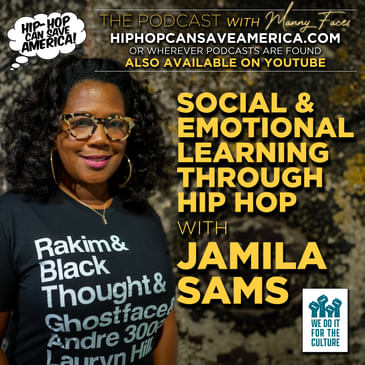
Manny Faces speaks with Jamila Sams, a passionate and visionary educator who is deeply committed to harnessing the transformative power of education to uplift communities. At the heart of her pedagogy lies a profound connection to Hip Hop culture, which she sees as a vital instrument for enriching the learning experience and fostering liberation.
Seeing a need to intertwine cultural relevance with learning, Jamila created "We Do It 4 the Culture," a groundbreaking social and emotional learning program. This curriculum speaks to students from grades 6 to 12, drawing on the rich tapestry of Hip Hop to engage and inspire, while promoting the social and emotional well-being of youth.
--
Hip-Hop Can Save America! with Manny Faces is a Manny Faces Media production, in association with The Center for Hip-Hop Advocacy.
Links and resources:
SHOW WEBSITE: https://www.hiphopcansaveamerica.com
ON YOUTUBE: https://www.hiphopcansaveamerica.com/watch
MANNY FACES: https://www.mannyfaces.com
NEWSLETTER (free!): https://mannyfaces.substack.com
SUPPORT QUALITY INDIE HIP HOP JOURNALISM: https://www.patreon.com/mannyfaces
Manny Faces Media (podcast production company): https://www.mannyfacesmedia.com
The Center for Hip-Hop Advocacy: https://www.hiphopadvocacy.org
SPONSORS / FRIENDS:
The Mixtape Museum: https://www.mixtapemuseum.org
Hip-Hop Hacks: https://www.hiphophacks.com
Hip-Hop Can Save America! is produced, written, edited, smacked, flipped, rubbed down, and distributed by Manny Faces.
Eternal thanks to Consulting Producer, Sommer McCoy.
[00:00:00] I am Brother Cornel West and this is Hip-Hop Can Save America! Hip-Hop Can Save America! Hip-Hop Can Save America! The thing about Hip-Hop today is it's smart. It's insightful. The way that they can communicate
[00:01:27] a complex message in a very short space is remarkable. And a lot of these kids, they're not going to be reading The New York Times. That's not how they're getting their information. Hip-Hop Will Rock The Shoppination 響 動 勢 撕落 音樂 Peace to you and speak the truth 展望 無依心 與 何為 無依心
[00:01:48] Hip-Hop Will Rock The Shoppination 唱 to something you do 唱 to something you live So Hip-Hop didn't invent anything, but Hip-Hop re-invented everything. Jamila Sams, good to see you. Hello. Peace, how are you, Manny?
[00:02:07] I'm doing fine. I'm doing great now that we're here together in this space. I've given folks on the live stream a little bit of, you know, little heads up on who you are and what you do.
[00:02:17] But if you could, tell me how we do it for the culture.
[00:02:22] Depends on who you're asking. So since you're asking me, what I do for the culture is I'm an educator for the culture. Everything I do is about using education as a tool for liberation and Hip-Hop is at the center of that.
[00:02:35] The founder of Go To Missy IMS Incorporated, which is a consulting company, and we work with schools to create positive, productive and equitable spaces for young people.
[00:02:44] And I also founded We Do It For The Culture, which is a culturally responsive social emotional learning curriculum rooted in Hip-Hop culture for grades 6 through 12. That's the main project right now, the curriculum. You've inserted this in schools throughout the country. You're consulting and putting it in these spaces.
[00:03:03] So for laypeople that might be coming into the room, some of us know who you are so we'll leave them for a minute.
[00:03:10] But the folks that might be learning about your work for the first time, what is a curriculum that's rooted in Hip-Hop culture and focuses on social and emotional learning, which is sort of the core of the competencies being served by this curriculum? What does that look like?
[00:03:27] So I'll start with social-emotional learning. So that's the art of naming our emotions and managing our emotions for personal and societal change.
[00:03:37] We leverage Hip-Hop culture within social-emotional learning because at the root of Hip-Hop, it's all about making sure that we're amplifying the voices, particularly of people that are often not seen, not heard and not valued.
[00:03:50] And so when we center our voices within these five social-emotional learning competencies, we're able to really tap into the whole person. And so when you think about self-awareness, that's the first SEL competency. We connect that directly to the fifth element of Hip-Hop, which is knowledge itself.
[00:04:09] And for me, knowledge itself has always been, even though it's the fifth element, I really believe it's the first element. From which all elements flow. Exactly, exactly. And when you think about human nature, it starts with self-awareness.
[00:04:24] And then the other SEL competency, self-management, how we manage our emotions. So we look at Hip-Hop culture as a tool for us to express ourselves through these various art forms.
[00:04:34] When we think about social awareness, Hip-Hop has always been the apex for making sure that we are raising awareness about things that are happening, whether it's in our local communities or on a global scale. Then you have responsible decision-making.
[00:04:50] For me, again, as a purist, Hip-Hop for me has always been about education and elevation. And then last but not least, we have relationship skills. And everything about Hip-Hop is connected to relationship skills from being the DJ, to break it, to being a cipher. It's all connected.
[00:05:11] And so what we've done in the curriculum is that we leverage content that students want to talk about, and we connect it back to those five SEL competencies and those five elements of Hip-Hop.
[00:05:23] This is amazing stuff because it's as I say to folks that do kind of the work that we try to do or the stuff we try to get across to the world but put it into a book I had Dr. Toby Jenkins on, put in a curriculum.
[00:05:36] What you're doing here, Yalla is able to package it in a way that makes so much sense and is so relatable but also importantly enough translates to the folks that aren't familiar with the culture.
[00:05:47] And with our movements and our music and our way of being our ethos translates into that. That's the importance of doing this as a curriculum, right? Yeah, absolutely.
[00:05:59] A lot of schools do not have the resources, sometimes even just teachers are struggling with the language in order to connect with students.
[00:06:08] And so because Hip-Hop is universal and is touching all young people no matter where you're from, I think just having that common language, the common culture experiences that they want to talk about then helps teachers to build deeper relationships with students.
[00:06:26] And so we kind of use that as a conduit for those conversations. Again, for folks like us that maybe certainly like yourself that have come up in not only Hip-Hop culture but Black culture, this is again the ethos that you live with.
[00:06:40] But not every teacher comes from either of those cultures or communities or the Venn diagram where they intersect. So they might look at this and I talk to music ed educators and regular folks who say, I like the sound of this.
[00:06:55] I like to connect to my children more. I work in a predominantly minority school district. Is this something that they can look at? How do you assuage their fears or their hesitations because they're not familiar or from these cultural backgrounds? Right, right. That's a really great question.
[00:07:13] And we're at stat a lot and we come across that in our daily work. What we do is we leverage Hip-Hop culture as a tool for storytelling. That's ultimately what it is. And a lot of teachers unfortunately were taught to teach content and not human beings.
[00:07:31] And so they struggle with vulnerability. They struggle with empathy. They struggle with even just listening because they're so busy, you know, being, you know, a dictator instead of a facilitator. And so what the curriculum does is gives them a resource.
[00:07:46] So what we're learning is that teachers are finding more about themselves through the curriculum, which is then impacting the students. And so we've had a lot of teachers say, you know, I wasn't prepared. I wanted to talk about what's happening with George Floyd, but I didn't know how.
[00:08:05] And so your curriculum gave me a tool for me to, A, understand that I need to create a space for students to just be able to hear their own voices. It's not about my voice. It's about the student's voice.
[00:08:18] But your curriculum gave me the resource and the tools in order to create that space. And it made me look at myself and maybe some biases that I had a little differently.
[00:08:28] And so what I love about it is that it's not just impacting students, that's the L competencies, but it's also impacting the adults and causing them to be more reflective and step out of their comfort zone to have more vulnerable conversations with young people.
[00:08:45] What are some of the results of that? Like what have you seen from teachers or heard from teachers?
[00:08:51] You said they want maybe a couple of just more anecdotes where they say, I have now been able to do this thing that I didn't expect to be able to do. What are some of the kind of the success stories?
[00:09:02] Yeah, a lot of them are saying that the communication. So just to backtrack a little bit, most of the schools that use we do it for the culture use it during the time of day called advisory or a social motion learning block.
[00:09:16] Now that's a whole nother conversation because social motion learning should be happening all day, not just in a block. But it's like social and emotional learning months. Right. It is actually SEL week next week. But yeah, but it should be every week should be. Yeah. Right.
[00:09:35] It shouldn't be looked at as another thing to do. It should be something that is embedded in, you know, your daily practices. But with that said, most schools use we do it for the culture during advisory. And so advisory can either well first let me define advisory.
[00:09:50] It's a time of day where teachers kind of take off their teacher hat and they serve as a mentor or coach to a small group of students and they get to know those students really well.
[00:09:58] And it helps to build kind of a sub community within the larger school community.
[00:10:03] So those students get to know each other well and, you know, a lot of times schools bring their advisories together for different experiences or competitions anything to help make the community more positive and equitable and inclusive of all students.
[00:10:18] And so during advisory, when they're using the curriculum what we're noticing is that they use it at least 40 minutes a week that the connections not only between students to student are stronger. But now the connections between the adult and students is even stronger.
[00:10:34] They're noticing that students that are more apt to not speak a lot of introverted students are starting to speak up because now again they're creating the safe embrace space where you know they feel comfortable in making their voice heard.
[00:10:47] And so that for us, that's what it's all about. You know we can do a lot of independent studies, research studies and all those things but it's hard to just measure humanity right just the connections that we have between people from different backgrounds.
[00:11:04] And so that's you know that's what we're most proud of. What's so now the opposite of that I guess is what's not the opposite what are the failures and I'm not saying that I'm saying.
[00:11:13] You said teachers don't like to be vulnerable nobody likes to be vulnerable right nobody likes to put that on display and so what are some of the things that I guess social emotional learning or social emotional teaching or the teaching of it is become you know more prevalent in educational spaces.
[00:11:28] Right. And so what are the fears and hesitations that that teachers specifically have that this helps kind of overcome I guess. Yeah, a lot of even myself when I was in my educational process and become the teacher.
[00:11:44] You know there's this stigma like don't smile until November right you always have to look like you are the head of your class and control your, you know they actually use words like control your classroom.
[00:11:55] And so it is a very, you know top down oftentimes creating spaces for more, you know what things happen more punitive measures. That's not the type of environment that we want to create.
[00:12:06] And so helping teachers to kind of unlearn all of those things, you know, talk about the miseducation of teachers. Right. You know that's one of the shout out to Lord Hill that's one of the things that they need to change.
[00:12:20] And for a lot of them, especially those that may be, you know, a little older. It's hard for them to kind of get out of that mode.
[00:12:27] However, once they do they're able to see that okay, as a human being I'm just maybe a little older but I come to the table with all of these experiences as a young person you're coming to the table all of these experiences.
[00:12:40] What experiences do we share what experiences can we learn from each other. And so for those that are reluctant nine times out of 10, those same adults that struggle with building relationships with their students. They struggle building relationships outside of the school, outside of the workplace. Right.
[00:12:58] And so, you know they may be really passionate about their content area you know I really love science I really love math, but I don't know how to make math connect to my students.
[00:13:10] So if you're not able to make that connection. What are you doing right and hip hop can be a conduit to that too like this is you just said content area it's content area agnostic.
[00:13:21] Right in a way it doesn't matter like you could be a math or a science teacher how does that like specifically as an example those connections can be made.
[00:13:29] Yeah, like hip hop I learned geography growing up by listening to hip hop you know, you know, AFR I see a Angola so wait goes in Bob way I can break it down right.
[00:13:39] Like I learned geography. I learned you know mathematics you know listen to y'all zine day most stuff like hip hop is universal and just the science behind hip hop, the rhythm the beats you know counting the measures.
[00:13:53] You know I grew up playing the piano and I had a metronome and I had to count the measures like you know all of that is connected to hip hop hip hop culture spoken word making sure that you bring in different binoculars and all those things.
[00:14:08] And all those things into your ELA classes like it's so connected.
[00:14:13] I think the biggest space where we see a lot of teachers not just using we do it for the culture in their s EL blocks or advisory broadcasts is they're starting to use it in their English classes in addition to their history classes.
[00:14:27] Because again, we think about you know promoting social justice and social awareness. You know there's a lot of stories that go into that work.
[00:14:36] Right now we're about to create a lesson to elevate youth voices in Palestine so looking at MC Abdul, his latest track paying greater than a sword.
[00:14:47] Like that's a powerful track coming from a young person, but from a historical perspective now you can connect what's happening right now to what's been happening, you know for decades. So these are just ways that you know hip hop is impacting education.
[00:15:02] And I'm really glad that more schools are open to seeing the power of hip hop pedagogy in their schools. Now that's my next question. Actually, we talk about this do a lot of folks that are trying to get into the schools get into the systems.
[00:15:15] Is it become easier in the past few years and obviously the perception against hip hop. You know, we don't have to harp over it. We all know what that is generally speaking.
[00:15:25] We also know that all these things that you're saying this isn't like overnight this has been happening we got the receipts. It works it's effective and there's been programs and research and literature and all the things.
[00:15:36] So overall do the as you approach schools or schools approach you maybe is that that hesitation lessened over the past few years are we getting into better space with being able to do this on a greater level.
[00:15:48] I also look at things like what states like Florida doing I'm like well they're not going to go for like how does that work you know in the in the general grants. I think that's the scheme of things.
[00:15:56] Yeah, I think when school districts wanted bad enough they'll figure out a way right and so based on what you just said, I will say like we have curriculum happening in schools in Texas.
[00:16:09] And because we're on a public platform I'm not going to tell you which ones because you're such a there's such a disdain there's such a right right. I don't even want to bring that district up but to know in Texas is happening.
[00:16:24] I think the importance is how bad do you feel as though your students need it right. And so we're now in districts that I never expect we would be in like where our largest our second largest is probably Portland Oregon.
[00:16:37] And we know about all the different racial tension that Portland has, you know experienced over the years. But now, and you still we still have a percentage of teachers that are not 100% on board. But here's the thing about this right.
[00:16:53] I'm going to ask why what's holding you back. Right. Why don't you want to engage in this conversation let's get rid of it so right and this is just the this is just a conduit to having much bigger conversations.
[00:17:07] About race about equity about economics about you know biases like this is what we're going to talk about. And hopefully by the end of this conversation this experience, you're a little more you know interested in getting past those personal barriers that you're creating for yourself to actually create.
[00:17:27] Essentially that's what they are. It starts with us grownups doesn't it. It absolutely does. Yeah, it absolutely does. And then to your point earlier you said most of us understand the culture but unfortunately that's not the case.
[00:17:42] We're seeing more and more that a lot of people still have this perception of hip hop culture as rat culture and I'm one of those people where I make the distinction.
[00:17:54] And so when we go into a district or school we do trainings or we may be doing a pilot.
[00:17:59] I make sure that I, you know separate rap culture and you know whether it's you know homophobia sexism violence all of those you know narratives I separate the capitalistic side of the culture from what it was originally intended to be.
[00:18:18] So I make that distinction because there are still a lot of stereotypes about what it means to be a part of hip hop culture. And so by having that conversation alone, a lot of teachers then start to let down their guard a little bit.
[00:18:32] Yeah, also having media outlets with people that also emphasize that very important fact that gets lost in the sauce. Absolutely. And so it's important to erase those narratives.
[00:18:46] Yeah, I mean not erase but confront them and make the distinctions that you do and that's important because as we know again this is just saying things that we inherently know.
[00:18:55] Finding a way to get it into the right places and drop the seeds in the gems in front of the people who have the ability to make the world a better place through their positions. So that's the work and it's wonderful.
[00:19:09] I'm gonna ask you a couple questions about the specifics of the thing that I found really interesting but I just want to, before I forget, there are schools that take, I'm just getting into the logistics of it.
[00:19:19] Schools that accept the curriculum can teachers do this independently or does it have to come through the school districts? So if teachers are like my district is not going to go for it but on the low, you know, I want to get involved as best possible too.
[00:19:32] Yes, absolutely. So we have parents that sign up and I was going to answer parents too. Yeah, absolutely. Okay, thank you. Yeah, parents, teachers, you know, program providers for youth development programs. So it runs the gamut.
[00:19:46] Yeah, okay. Good. So like you said, it's universal and that's great and it's accessible. So that's fantastic. I love how you tied in earlier so the knowledge of self to self awareness, like these parallels right to the pillars of the tenets of social emotional learning.
[00:20:00] I loved how on the site we do it for the culture.com you list some of the lesson plans and some of the, you know, the ways you do this, the ability like what you learn from being a DJ, you know, and like the things you learn about, you know, I'm been a DJ for I've been everything but I've been a DJ for a long time.
[00:20:18] And the idea of just like, and again, we don't we know this but we don't hear it sometimes even DJs that are connected to the culture and all up in it.
[00:20:26] Say that reading of the room, you know, I mean that ability to know what's happening to judge it like that's a that's a that's a very social skill. Yeah. Yeah.
[00:20:37] So so give me a couple of those like parallels of like something we wouldn't expect to know. I mean we talk about the power of the cipher and Tony Blackman's talked about how you know what to do in the cipher.
[00:20:47] No one tells you what to do in the cipher but you just learn you the social cues. This is the stuff we're talking about right.
[00:20:52] Yeah, absolutely. And so there's a segment of our training that we do with teachers and we talk about the five different elements of hip hop, and we get them to connect because oftentimes teachers don't even realize that they're doing some of those things naturally, you know, whether it's all in response, you
[00:21:10] know, that's relationship skills right and I've seen that the sitting in a circle, you know, like this is the way we communicate better. Yeah, that's the cipher.
[00:21:16] You know this. Yes, absolutely. And so you know what we try to get them to do is push themselves a little further. So how do you get to the point where your, your classroom can operate like a cipher without saying these are the rules of our classroom right
[00:21:32] because in a cipher there are no rules right but people respect the flow. And so helping teachers understand how to you know ways to cultivate the environment, so that it just flows naturally and students aren't disrespecting each other.
[00:21:47] You know they're not talking over each other there, you know they're connecting what their voices to other voices seamlessly like that is what we're trying to get them to understand a lot of these things they may already be doing.
[00:22:01] Yeah, they serve as you know the MC for their classroom but they're not the only MCs all of those young people in front of you their MCs to right and so how often are you giving them the bike. Are you holding the mic the whole time or you
[00:22:16] And so we make all of these you know analogies and connections to get them to understand that again, this is great teaching right hip hop is pedagogy in action and getting them to understand that they're doing it already or they're not doing it.
[00:22:33] Let me help you figure out ways that you can cultivate the space so that these things are happening a little more organically and your students are engaged.
[00:22:42] I love it and as many of us who end up where where we are where you are. It's not a straight path. I just get some curious like how you got here how you got to doing this like what I this will probably take a long time if you're like anyone else that has a lot of
[00:22:57] Converting bring it out the path so we can get the cliff nose version but you know sort of what was your connection to hip hop how did you take that in education and then how did this kind of evolve out of it those three key key milestones in your life.
[00:23:11] Yes, I'm definitely going to give you the quicker. I get it. People ask me to I'm like I'm a I'm got some years on me. That's gonna be a while. A lot of things happen along the way. But tell me yeah. Yeah, I'm curious.
[00:23:23] I will share the foundation. I will definitely share the foundation. So I'm from where yeah I'm from Philly. My father's from Harlem.
[00:23:33] My mother's from Bermuda so my hip hop really came from my father. So he's you know as Jay Z said you know he was a type of guy that can sell water to a whale right so he's always had the gift to gap when I was young about eight years old.
[00:23:47] He started a store in West Philly called the what's happening now shot.
[00:23:53] Okay, he was so in tune with his community that he positioned and he was a he was a salesman right so he positioned the store it was kind of like a bodega or a port of store.
[00:24:05] He positioned it right next to three schools so we were right behind West Philly High School. So in any given day the shop will be flooded with high school students coming from West Philly High they were coming to get their fat shoelaces their penny candy you know slurpees you name it they were in there or icings as we call them in Philly.
[00:24:27] I'm a new Yorker with slurpees I get it. So that was the spot that was the place to be and so he would pump you know his favorite song was jam on it.
[00:24:39] So he will pump out music in these big woofer speakers and literally like his is just coming in droves coming to the spot.
[00:24:46] It was the spot and so I'm eight years old behind the counter you know, and I just see it and it's a vibe right before I knew what a vibe was it was a vibe.
[00:25:00] And that just always stuck with me and he would just he would be the first one to bring in you know the mixtapes.
[00:25:07] I remember he I remember he brought me my first EP and B you know, you know, cassette tape like he would be the one to bring me all this because now he had relationships with the local DJs and radio stations and so later on, my dad became a printer.
[00:25:22] So he's he and my mother started a company in Philly called inference unlimited. They would make the passes the backstage passes and the tickets for all of the shows. And so they sold the business that now my dad's an ancestor so I can say this now.
[00:25:38] So I would get on my backstage passes. One fell off the branching bread. Brilliant. All my backstage passes. So there's I've seen so much about the plug. Yeah, right? So yeah, so I had so many experiences. So I was just like embedded in the culture the entire time.
[00:26:07] You know, the entrepreneurial aspect of it on third generation entrepreneur. So fast forward to me becoming an educator. I became an educator and I talk about it in a couple public spaces but a long story short, I was involved with somebody that really wasn't good for my health.
[00:26:23] And he had two nephews that were not they were young and they weren't being taught their ABCs one, two, three's. And I was in a weird place in my life where I was spent a lot of time with those two young people.
[00:26:39] And I realized that I enjoyed going there not to see the knucklehead I was dealing with at the time. But I was enjoying bringing books and reading to them and teaching them ABCs and one, two, three's.
[00:26:50] And then when I went to I went to Lincoln University in Pennsylvania and I was an I became an education major because the mark I wanted to be a creative director but they didn't have that program.
[00:27:02] So I ended up being an education major and that literally changed my life. And so I've always used hip hop as again like a conduit something to connect because I was really into hip hop.
[00:27:13] And I just also assumed that all students across the world were interested in hip hop. So when I moved from Philly to Baltimore, I got a rude awakening from a cultural perspective. Now I'm only 21 years old so I just make all of these blanket assumptions. Right.
[00:27:29] They were like now we listen to club music and so I was like, oh word. So now I have to shift right? So I bring in some house you know but I will also bring in some club.
[00:27:39] And so I was still bringing the house that's connected to like, you know, jungle brothers and things of that nature. The hip house. But I will still learn like who are you all listening to? And so I will bring that into the space.
[00:27:54] And then eventually I became an assistant principal and after that just started my own company because I wanted autonomy and I wanted the ability to help schools create these spaces.
[00:28:06] I had, I was really blessed to come from schools that had really great leadership and built really strong community. And I wanted to replicate that for other schools across the nation. So that's why I kind of started the consulting business and then through that work,
[00:28:21] I really noticed that schools didn't have a culturally responsive SEL curriculum to use with their students. A lot of it is very, you know, leave it to be very, you know, very outdated concepts. Right. That's not the way they learn.
[00:28:38] They have to be fully immersed in whatever it is that you're talking about. So you got to make those authentic connections and that just wasn't happening with the curriculum that was out there. And so I just decided, you know what?
[00:28:48] I need one that's going to center the culture, center our voices. And that's why I created We Do It For The Culture. So a little longer than the Cliff Note version. No, I love it. I love it.
[00:29:01] I was born right outside of Philly actually but I'm not a group on Long Island. So when you say PMD, I'm like, yeah, that's what's up.
[00:29:07] And I also know, I happen to know because I watch other interviews that we share our number one top five that are alive in Rock Him. So Strong Island in the House. Absolutely. Absolutely. A couple more questions before you go if you could be so kind.
[00:29:20] One is, and this is the overarching holistic question right in the field, in the work that you're doing. You know, it seems to some of us and I'm sure some sometimes yourself maybe and folks that work with you.
[00:29:34] That while these strategies and integrations and intersections are so valuable and are so good at helping uplift the educational lives of young people across the board. Right? Again, this is universal. This works.
[00:29:48] You know, a lot of times people say, well, you know, this will be great in the inner city. Yes. And it'll be, it can be used anywhere. There's white people in Idaho that like hip hop too or will connect to, they have to like hip hop.
[00:29:58] You'll connect to the, you know, because you listen to the music. Yeah. But also most important, it would probably be best beneficial to the lives and livelihoods and communities that have been traditionally underserved and under resourced and under loved.
[00:30:11] So for all the reasons this is brilliant work and it's important and vital for the equality and equity of our nation as a whole. Right. Not everyone wants that though. Right. And so you have states, you have districts, you have perhaps on a federal level.
[00:30:26] You're going to have, you know, this is not an easy battle even though the receipts are clear and, you know, and we feel good about it.
[00:30:34] Right. Overall, I don't want it to seem like it's hopeless that this would ever be something that could be used in a mass scale. I know people ask that all the time. I was just at a panel here in Atlanta.
[00:30:45] I'm in Atlanta these days. I did the thing that New Yorkers do when I moved to Atlanta. And it was about the intersection of hip hop and social justice.
[00:30:50] And one of the questions was, I'm sure there are people doing this kind of hip hop education integration that came up in pockets over here and over here and over here. But as there's no like web or connectivity or whatever.
[00:31:03] And I said, well, first of all, you know, hip hop ed, you know, check out the family that does that. And there is a coalition. Let's just say. Yes. Yes. Yes. Shout out to the fans.
[00:31:11] So again, I'm asking the list of them asking to solve. Can you solve the whole thing in one sentence?
[00:31:14] But I'm saying like, what do we have to do as a society, as individuals to help make this be more widely understood or more widely adopted in the education system as a whole?
[00:31:26] Like what are some of the things besides obviously bring the curriculum in and do all the things. You know what I'm saying? I know it's a big question.
[00:31:32] Right. It is a big question, but kind of like the individual conversations that I have with teachers all over the nation when they are reluctant. I asked why. Yeah.
[00:31:43] And that is those three letters lead to such great conversations because a lot of times, you know, we don't know what we don't know.
[00:31:56] And the reluctancy for us to figure out what we don't know means oftentimes I now have to give up something that I have I've told I've held on to for so long. I have to give up an ideology that I've held on to. It's big in. Yeah.
[00:32:18] Yeah. Yeah. Yeah. And if I give that up, who am I? Right. And a lot of people do not want to peel back those layers because of fear. Yeah. Period. And so if we can address that, then people may take down their guards to learn something new.
[00:32:40] And so I think it has to start with reflection. I think it has to start with us asking why and that's for all of us, right? Because we all have rights that we need to address.
[00:32:52] And so when we ask those, peel back those layers and ask ourselves why then we also have to listen. I feel like now, you know, listening is, you know, thank goodness for podcasts with people are starting to listen more.
[00:33:06] But, you know, listening is an art. It's not about thinking about what you're going to say before the person is finished speaking. It's about literally listening and then feeling what they're saying empathize with what they're saying and then doing the research. So don't take anything for face value.
[00:33:24] Go into the research behind what was just shared. And so those three things, self-awareness, getting out of our comfort zone and pushing past the fear, accepting the fact that we may have to let go parts of ourselves that we've held on to for so long.
[00:33:42] And then building those connections and doing the research. Most people don't want to do that because they're an autopilot. And so, you know, I'm grateful for, you know, podcasts like yours and, you know, platforms and curriculums like mine that is helping people to kind of pause and think.
[00:33:59] And when that happens, you know, I think it's magical once we can break down those walls and those barriers that we create for ourselves.
[00:34:07] Yeah, for sure. And in fact, those three things, you know, being, you know, coming out of your comfort zone and relationship skills, that's all stuff you can learn from hip hop. So anyway, it's all part of the game. It's all part of the same. It's all connected.
[00:34:21] I love it. I'm very, as you know, as I think, you know, or you should know, you know, obviously been watching what you've been doing for a long time and wanting to talk to you about it for a long time.
[00:34:29] I think that this serves to do some of that. Like when folks listen, I know we preach to the choir a little bit, you know, I know with a lot of folks that follow all these ideas, listen to the show.
[00:34:37] But I do know for a fact that there are folks outside of what we do that pay attention. And this is a perfect primer to some of that, to start asking those questions or having them ask those questions to themselves.
[00:34:50] So I welcome folks to do that, you know, write in, tell us what you think. Talk to, you know, reach out to y'all over there. We do it for the culture, the number four culture.com.
[00:35:00] And I'll leave you, unless there's anything else that, well, let me ask you this and then I'll ask you that last question that I like to sometimes sneak into this is, I did name the show hip hop can save America.
[00:35:10] That's a very lofty idea. And we may need a little bit more than just hip hop. But without giving you the reasons why I named it that and why I believe in that sort of philosophy.
[00:35:21] What do you think of when you hear that statement when you first heard that and your thoughts when someone says, hip hop can save America? Yeah, you can't heal, which you're not willing to confront.
[00:35:33] And so I feel like hip hop can save America because it puts at the forefront all the different social ills that this country has given birth to for over 400 years. And it puts it right in your face and you can't run from it.
[00:35:51] So you got to be able to confront it in order to heal. And so the way that we confront is through social justice work, through education, through cultural exchange and understanding, through political engagement, through mental health awareness.
[00:36:05] But all of those things are right at your face front and center through hip hop. And you can either run towards it and heal from it or run away from it. But hip hop is still going to keep going. We don't die. We just multiply like gremlins.
[00:36:19] That's right. I hear you. Well, I appreciate that. I appreciate your work. I appreciate your time and your perspective and your insight and being so generous in coming on here and talking about what you're doing.
[00:36:33] Is there anything else that the program has got coming up that you personally have going on that you want to share with the folks who might be interested in hearing what's next or what's ongoing? Yeah.
[00:36:43] I'm excited to launch a series of asynchronous lessons so that teachers can actually log on and get some self development work outside of us coming into doing training.
[00:36:54] So we're really excited about that and we're looking forward to working with some really dope educators and practitioners in the space to collab on some of these. And so we're really excited about that. But right now we're in 15 states and growing.
[00:37:07] And you know, we're just we're just grateful for the opportunity to make an impact. Well, I hear that. I'm grateful for the opportunity to know you and to amplify and signal boost what you're doing.
[00:37:18] And you're welcome to come back anytime you have some new things popping that you want us to share with the folks. But other than that, I really thank you for your time. I appreciate you. Thank you. Thank you for everything that you're doing for the culture, Manny.
[00:37:32] I appreciate that appreciation. Once again, thanks for listening to another episode of Hip Hop Can Save America, a.k.a. The World's Most Important Hip Hop Podcast. My name is Manny Faces. You can find out more about the show at hiphopcansaveamerica.com.
[00:37:44] You can watch the show now as a live stream on YouTube, hiphopcansaveamerica.com. Check back for all the replays as well. The interviews from the live stream will be brought here onto the audio feed so you always get the best of the live stream.
[00:37:57] You can also check out our sub stack newsletter. It's free at MannyFaces.substack.com filled with stories of hip hop innovation, inspiration and in general hip hop news that isn't about the world. Dumb s***. Eternal shouts to our consulting producer, Summer McCoy.
[00:38:13] Be sure to check out her dope initiatives, Hip Hop Hacks and the Mixtape Museum. We'll be back soon with another dope episode, but check us out on the live stream as well. Monday is 9 p.m. Eastern. Hiphopcansaveamerica.com slash watch.
[00:38:25] Until next time, it's Manny Faces wishing peace and love to you and yours.

WATCH
HIP HOP CAN SAVE AMERICA!
LIVE ON YOUTUBE
MONDAYS, 9PM ET
WITH REPLAYS ON DEMAND