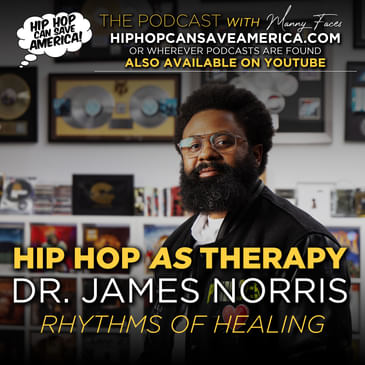
In this eye-opening interview, Manny Faces sits down with Dr. James Norris, the "other Dr. J," to explore the groundbreaking Rhythms of Healing initiative. Learn how this innovative program is:
- Using Hip Hop as a powerful tool for adult mental health
- Bridging the gap between traditional therapy and cultural relevance
- Empowering communities with self-healing tools rooted in Hip Hop culture
Highlights include:
✓ The difference between using Hip Hop for connection vs. healing
✓ How Hip Hop can rewire neural pathways and promote healing
✓ The importance of culturally relevant therapy for adults
✓ Exciting new Hip Hop counseling certificate program for professionals
---
Please support this show: https://www.patreon.com/mannyfaces
---
Whether you're a mental health professional, educator, or Hip Hop enthusiast, this conversation offers invaluable insights into the transformative power of Hip Hop in therapy and community healing.
Dr. Norris breaks down complex concepts like neuroplasticity and explains why Hip Hop is uniquely positioned to address trauma and promote wellness in underserved communities.
Join us as we explore how Rhythms of Healing is creating a new paradigm in mental health, bridging generational gaps, and proving that Hip Hop isn't just music – it's a powerful tool for personal and community transformation.
Subscribe for more conversations on Hip Hop's influence in education, mental health, and social change. Hip Hop can save America – and heal it too!
Dr. Norris's Hip Hop Counseling Certificate Program: https://james-norris.mykajabi.com/offers/QzK3V8HC/checkout
----
Hip-Hop Can Save America! with Manny Faces is a Manny Faces Media production, in association with The Center for Hip-Hop Advocacy.
Links and resources:
SHOW WEBSITE: https://www.hiphopcansaveamerica.com
ON YOUTUBE: https://www.hiphopcansaveamerica.com/watch
MANNY FACES: https://www.mannyfaces.com
NEWSLETTER (free!): https://mannyfaces.substack.com
SUPPORT QUALITY INDIE HIP HOP JOURNALISM: https://www.patreon.com/mannyfaces
Manny Faces Media (podcast production company): https://www.mannyfacesmedia.com
The Center for Hip-Hop Advocacy: https://www.hiphopadvocacy.org
SPONSORS / FRIENDS:
The Mixtape Museum: https://www.mixtapemuseum.org
Hip-Hop Hacks: https://www.hiphophacks.com
Hip-Hop Can Save America! is produced, written, edited, smacked, flipped, rubbed down, and distributed by Manny Faces.
Eternal thanks to Consulting Producer, Sommer McCoy.
[00:00:00] I am Brother Cornel West and this is Hip Hop Can Save America
[00:00:45] The thing about hip hop today is it's smart.
[00:00:49] It's a great way to support it. We'd love to have you aboard as a supporter at patreon.com slash mannyfaces.
[00:00:56] Now let's go.
[00:00:57] The thing about hip hop today is it's smart. It's insightful.
[00:01:06] The way that they can communicate a complex message in a very short space is remarkable.
[00:01:14] And a lot of these kids, they're not going to be reading the New York Times.
[00:01:17] That's not how they're getting their information.
[00:01:20] My hip hop will rock and shout the name. Hip hop culture is more than music.
[00:01:25] Teach to you and speak the truth. Showing what peace can do when they're ways for you.
[00:01:30] But hip hop will rock and shout the nation.
[00:01:33] Rap is something you do. Hip hop is something you live.
[00:01:36] So hip hop didn't invent anything. But hip hop reinvented everything.
[00:01:43] Dr. James Norris, Dr. J. What's up my man?
[00:01:47] Man I'm good. How are you? Pleasure to be on here man.
[00:01:50] Ah no it's a pleasure to have you. I'm doing alright. I see we got the East Coast West Coast hat game going on.
[00:01:56] Yes. Very good, very good. We're representing the whole nation. Hip hop can save all of America.
[00:02:04] Yes sir.
[00:02:07] I appreciate you. I appreciate you.
[00:02:08] Although I did the thing that New Yorkers do and I moved to Atlanta.
[00:02:11] So we got all coasts represented I suppose.
[00:02:16] And I always need someone from like, I don't know, Michigan, Minnesota.
[00:02:19] What's at the top? I don't know. I don't know geography.
[00:02:22] But what I do know is hip hop and I know some people that are doing some incredible work in that field and using the beloved culture of hip hop to help uplift humanity and improve society.
[00:02:32] That's what we talk about. That's obviously why we need to talk.
[00:02:34] You have quite a list of accolades and letters after your name.
[00:02:39] So instead of just reading off a bio, which sometimes we do, please, if you would introduce yourself to our audience in the way that you like to be presented to the world.
[00:02:47] So my name is Dr. James Norris, but people call me Dr. J.
[00:02:53] I'm the other Dr. J.
[00:02:55] Right.
[00:02:56] And I'm currently assistant professor at the University of Cumberland.
[00:03:01] I'm also a licensed mental health practitioner in California, Washington State and Arizona.
[00:03:08] I'm also, you know, rooted in doing the mental health work.
[00:03:13] Been doing that for about 12 to 15 years in different capacities.
[00:03:19] And so, yeah, I'm here. I grew up in the L.A. area, lived in Seattle, but back home in L.A. now.
[00:03:26] And yeah, excited to be here.
[00:03:28] Yeah, man. No, I appreciate it.
[00:03:30] It's just such a wide range of things that you do that are valuable and worth talking about.
[00:03:36] Let's start kind of at the now, though, and then we'll backtrack a little bit to how you got here.
[00:03:40] I've known who you are and your work.
[00:03:42] There's a long list of folks that are doing good things.
[00:03:45] You're on that list that I want to talk to.
[00:03:46] But what really caught my attention is the Rhythms of Healing initiative that you've launched recently.
[00:03:51] So why don't we start at the now?
[00:03:54] Tell me about this new initiative, what it does, what it's about and what people need to know about it.
[00:03:58] And then, like I said, we'll figure out how we got here after that.
[00:04:00] Yeah.
[00:04:01] So how I got started, I connected to the co-founder Dana Mason actually over a year ago.
[00:04:10] I met her at a event on the 50th year of hip hop through a mutual friend.
[00:04:16] And and she was in the music business for 25 years and then moved into the holistic space.
[00:04:22] And then we started talking about what I do, what she's hoping to do and how we can bridge hip hop in the holistic and wellness space together.
[00:04:32] And so we ended up going on this journey of creating rhythms of healing, which was really not only just integrating, but also reclaiming and showing that the healing properties of hip hop.
[00:04:47] Right. And we'll use that through our skill sets.
[00:04:51] Me as a mental practitioner, her as a wellness and holistic trainer with both our love for hip hop.
[00:04:59] We're using our disciplines and hip hop as really as a bridge for people to walk across for their own healing.
[00:05:06] Yeah. One of the things that you say somewhere, maybe it's in the website or somewhere or you've said in an interview, a lot of folks use hip hop to connect.
[00:05:15] Yes. To different use it to connect to different cultures or bring folks into educational spaces.
[00:05:20] But you said there's a difference between connection and healing and the healing thing is something that has to be explored and utilized more often.
[00:05:27] So explain that difference and how rhythms healing, you know, focus on the healing part of the connection.
[00:05:33] Yeah. So just in my research and my work and my engagement with hip hop my whole life and not necessarily as an artist, but hip hop has just been a part of what I've consumed, you know, my whole life.
[00:05:47] And along with the research and what I found is many folks, which I think is important to is using hip hop to connect or as an intervention alongside of kind of other approaches. Right.
[00:06:01] Right. And what what I'm suggesting is that hip hop alone is its own healing property. Right.
[00:06:08] In of itself. In of itself. We don't need to add anything to it to like make it look pretty. If we just engage in hip hop and its roots in itself, urban youth was using it for self self-help. Right.
[00:06:22] That's its own property. And what I'm suggesting is we can use hip hop to heal with all its properties of emceeing, you know, beat making, b-boying, the fifth element, knowledge of self.
[00:06:36] Right. All these things are tools that we can that can create healing within humanity and people.
[00:06:42] And so that's what really our message is, is that hip hop is not just what you think it is, sexism, misogyny and all of these things that people try to put on hip hop while those things exist.
[00:06:59] But it's this other element of it that is that its roots have and it's healing and empowerment.
[00:07:06] Thanks. What does that look like in practice? So what is real rhythms of healing? How does it what kind of programming do you have?
[00:07:13] I know it's it's still kind of in its early life. You know, you just launched this recently.
[00:07:17] You have a couple of things that have like two different components to it. Yeah.
[00:07:21] Yeah. Yes. You know, since we started real rhythms of healing and that is the longer version.
[00:07:27] So it's about a 13 week program.
[00:07:30] Let me interrupt and just point out this is for adults.
[00:07:33] Yes. Yes. That's another fascinating thing about a lot of people immediately go to youth culture that this is when we talk about and there's great application of hip hop as a healing tool for young people.
[00:07:43] You know, people do that all the time. This is a little bit unique in that we don't see this a lot for for for grown folk.
[00:07:48] Yeah. I just wanted to point that out. That's that's an important component here.
[00:07:52] So tell me about how what it looks like. Yeah. So we need it to man.
[00:07:55] And now, you know, we do, you know, as well.
[00:07:59] It's a cohort model. And so we'll have 13 individuals come into the cohort and then we'll go through a 13 week process.
[00:08:08] Right. And in that we'll be talking about what wellness will have meditation.
[00:08:16] And so it'll be a blend of the metal meditation and the social emotional development along with hip hop infused in that.
[00:08:26] And what that means is we'll have like lyrics and then doing lyric breakdown.
[00:08:32] Right. As it pertains to wellness. Right. Well, balance. Right.
[00:08:36] As it pertains to resilience. And so we'll have lyrics or artists sharing their experience through hip hop.
[00:08:44] And we'll be sharing that with folks to really break down, to share their own lived experience. Right.
[00:08:50] And so it's so we're going to be engaging in hip hop through the lyric standpoint.
[00:08:55] And we're going to ask individuals in the beginning to list their top five or the individuals they listen to.
[00:09:03] So we can be integrating that into the content, because the whole goal is using hip hop as the foundational piece.
[00:09:11] Yeah. To help people share their lived experiences, their challenges, their mistakes.
[00:09:17] Right. Their regrets. Right. Through the music. Right.
[00:09:21] Because what I find as a clinician is sometimes it's hard for people to really communicate their story linguistically.
[00:09:30] Right. And to use hip hop as a bridge for them to do that, whether it's writing or using someone else's lyrics to really help share their own is the basis of our framework.
[00:09:45] Yeah. Going through your history as a clinician, as someone that was doing this work, surely you didn't start incorporating hip hop into your therapy the minute you started in this field, because that's not a thing that is automatic yet.
[00:10:00] You know, these days. How did you as a hip hop head, like you said, you're not an artist, but you're a hip hop guy work that into what you decided to go down a path as your career?
[00:10:11] When did that transition happen? Was it was it something that you thought you wanted to do?
[00:10:16] Was it something you experienced elsewhere? How did how did you start mixing these these worlds?
[00:10:20] Well, so when I when I was in my master's degree, I got my master's degree in a psychology program.
[00:10:29] But the basis of the program was around existentialism and phenomenology.
[00:10:34] And so basically existentialism is about existence. Right.
[00:10:40] And then phenomenology is about individual subjective experiences. Right.
[00:10:45] And so when I start diving into that, really understanding what happened in people's lives or what experiences they have really impacts how they exist in the world.
[00:10:58] Right. And that and then that also gives them a subjective experience of how they want to be and exist and how they want to present themselves.
[00:11:07] And I mean, an existentialist wouldn't say this, a traditional one.
[00:11:13] But for me, that's hip hop. Hmm. Right.
[00:11:16] Hmm. Because those experiences engaging in hip hop culture really shape how you exist in the world.
[00:11:24] Right. And what your subjective experiences are.
[00:11:27] And so while I was doing this work, not necessarily, you know, attaching hip hop in it.
[00:11:32] When I was engaging with youth, adults, I was really connecting to their lived experiences. Right.
[00:11:39] And helping them navigate that to live a healthier life.
[00:11:43] And so as I was moving through that work and then got into my doctoral studies and started really looking at this because hip hop has always been in the backdrop of everything that I've done.
[00:11:55] That's right. And when you when you're of the culture, it follows you around.
[00:12:01] Yeah. It's how you see things. It's how you see things.
[00:12:04] And then I started reading literature and seeing other folks talk about it.
[00:12:08] The M.Dens, the Levy's, Dr. Raphael Travis, some folks from Oakland.
[00:12:15] And so I was in my reading as well, I was in my doctoral studies and I was like, man, this is this is it.
[00:12:23] How can I incorporate this in my work?
[00:12:26] Because not only is it so relevant, but I started to reflect on my own life.
[00:12:32] Right. And realize and I tell people I can't remember a time when music.
[00:12:40] Didn't exist in my life.
[00:12:42] Right. Right.
[00:12:44] Hip hop, R&B.
[00:12:46] I tell people I still remember my mom when I was a kid playing the Mary J.
[00:12:50] Blige's album, My Life, the whole album.
[00:12:53] Right. Right. Right. Right.
[00:12:54] Right. I remember having the Me Against the World CD, the CD.
[00:12:59] Right. And putting it in a CD player.
[00:13:01] Right. And so these things were also connected to my healing and lived experience growing up.
[00:13:08] Right. Right. And so influence.
[00:13:10] Yeah. It's not just, you know, as you said earlier, as you alluded to, it's not always like the negative experience.
[00:13:15] It's just the experience. It's the whole, you know, human experience.
[00:13:20] Yes. Right.
[00:13:21] That you push and pull from music slash culture.
[00:13:25] Exactly. Exactly.
[00:13:27] You know, it's not a planned question or whatever. This is just now us kicking it.
[00:13:31] But like, it's also something about hip hop that does that in a, I guess, deeper way than other genres or other subcultures.
[00:13:39] It's something that's more, I don't know, visceral. Right.
[00:13:43] What's what's why? Why hip hop?
[00:13:45] Why? Why does this? This is what people don't get who are not associated with.
[00:13:48] So how do you explain to folks who are outside of this when you're doing psychology work and they're like, yes, it's music.
[00:13:53] Yeah. We all love music. I was shaped by music, but it's different. Right.
[00:13:57] I think what makes hip hop different is it's just not a musical genre.
[00:14:03] Right. Right.
[00:14:04] It's a culture. Right.
[00:14:06] It's a way of being in the world. Right.
[00:14:08] Yeah. Yeah.
[00:14:09] And so some people, they don't understand the depth.
[00:14:12] Yeah. Because you can play and I'm not saying country music because I went and saw Chris Stapleton and his his concert was off the hook.
[00:14:23] Right. Yeah.
[00:14:24] And so, yes, these genres, they're genres and they're powerful in their own right.
[00:14:30] But hip hop is inception. Right.
[00:14:33] Is birth changes how it is compared to other genres.
[00:14:38] It birthed out of this way of empowerment. Right.
[00:14:43] Raising one's voice. Right.
[00:14:45] Right. Social activism.
[00:14:46] And so it wasn't just, oh, let's do these beats.
[00:14:51] Let's rap.
[00:14:52] No, it built out of a community movement that gives it a lot more depth than just music.
[00:14:58] Right.
[00:14:59] That breaks it down well.
[00:15:01] So going back to the program, going back to your work, those communities from when hip hop came.
[00:15:06] Right. Generally are the ones.
[00:15:08] And of course, hip hop is universal.
[00:15:10] It's grown everywhere you find it, every corner of the world.
[00:15:13] However, going back to those communities, communities that have birthed it, nurtured it through all those years.
[00:15:17] They have been communities that have been traditionally underserved and under resourced and underloved by society at large,
[00:15:23] particularly when you talk about areas like mental health, health and wellness in general.
[00:15:28] Yeah.
[00:15:28] So obviously the work you do is to counter some of that.
[00:15:32] Speak to the importance of finding ways to counter ways that folks have been underserved in these fields.
[00:15:41] Why this work is so important and why is it important to me, too, is going to have gone through the traditional training,
[00:15:52] psychology, clinical mental health training and being a theorist myself,
[00:15:57] understanding that all the 10 conventional theories that individuals that are trained to be counselors,
[00:16:05] counselors, all those were built by white men.
[00:16:09] Right.
[00:16:10] Right.
[00:16:11] In a certain time.
[00:16:13] Right.
[00:16:13] As well.
[00:16:14] Right.
[00:16:14] A while ago.
[00:16:15] Yeah.
[00:16:16] And so I think that's important.
[00:16:18] Right.
[00:16:18] I think what's important, not so that they are white men will while people will point to that as heavy, too.
[00:16:25] But I think also the time in which they were building these.
[00:16:29] Right.
[00:16:30] These theoretical frameworks.
[00:16:32] And so what we have now is counselors coming out and they're doing work based off those frameworks.
[00:16:40] You know, they're trying to solve current problems with 20 and 19th century ideas.
[00:16:47] Right.
[00:16:47] Right.
[00:16:48] And so what I try to tell my counselors that I even teach as an educator, I said these theories,
[00:16:53] we have to remix them.
[00:16:55] Right.
[00:16:56] And they always crack up.
[00:16:58] Right.
[00:16:59] But then they were like, we do.
[00:17:01] And I like that.
[00:17:02] We got to remix them.
[00:17:04] And so part of my work is not negating the work.
[00:17:08] Right.
[00:17:08] That folks have done.
[00:17:11] Psychologists on the mind, human behavior.
[00:17:13] But how can I take that knowledge that I have and now remix it and make it applicable to this,
[00:17:20] to the communities and people that I'm engaging because linguistically, they're not going to understand that.
[00:17:26] Right.
[00:17:26] So it's part of my responsibility now to change that linguistically so they can understand how to live a healthier life without using jargon.
[00:17:36] That's foreign to them.
[00:17:37] Right.
[00:17:38] Right.
[00:17:39] Yeah.
[00:17:39] And the idea of culturally relevant or culturally responsive and culturally affirming, you know, all those lines.
[00:17:45] Yeah.
[00:17:46] And so the other piece of it, too, for me is, is letting folks know that we have the tools to heal within our community.
[00:17:57] Right.
[00:17:58] We don't need necessarily this outside entity to give us something to be to be better in our lives.
[00:18:05] Right.
[00:18:06] Right.
[00:18:06] Right.
[00:18:06] It's already embedded in us.
[00:18:09] So I just believe it's helping people find that and cultivate that.
[00:18:13] And we see that all the day long in hip hop.
[00:18:16] And I think a perfect example to point to is a Nipsey Hussle.
[00:18:21] Right.
[00:18:21] All the things that the world got to see eventually.
[00:18:24] You can't tell me those things weren't in him.
[00:18:27] He just began to cultivate those things.
[00:18:30] Right.
[00:18:31] Right.
[00:18:31] But then and so and that blossomed into the person that we eventually saw.
[00:18:36] And so part of the work is letting people know that we have these tools and we can use the things available to us.
[00:18:44] The things that we listen to every day we do every day can be affirming for us to get to where we want to be on a positive tip.
[00:18:52] Yeah.
[00:18:52] It just makes sense.
[00:18:53] Yeah.
[00:18:54] To a lay person.
[00:18:56] You know what I mean?
[00:18:56] Like, you know, I've heard enough folks talk about this stuff to know that, like, obviously, you got the receipts.
[00:19:02] It works.
[00:19:02] We've seen it work.
[00:19:03] Like you said, you've seen examples.
[00:19:04] That's a great example.
[00:19:05] But it's the it's the ability to not have to go outside of the community.
[00:19:10] Right.
[00:19:11] To you.
[00:19:12] But you still have to extract from within the community because it's not something that's that the community knows how to do yet.
[00:19:17] Yes.
[00:19:18] Yeah.
[00:19:18] And those stigmas are still there.
[00:19:19] No, they are still.
[00:19:21] They're still there.
[00:19:22] They're still there.
[00:19:23] And this helps.
[00:19:24] But this helps break through those barriers.
[00:19:26] No, absolutely.
[00:19:27] And I think that we're the more that we're talking about it, the more that folks are being open about it.
[00:19:34] I think it's great.
[00:19:36] But I always say where we have to be careful at is when we start talking about people are talking about mental health and the importance of it a lot now.
[00:19:46] And where we have to be careful is there are people that want to capitalize off that financially on the suffering of people.
[00:19:54] And it's not genuine.
[00:19:56] And so that's why we also have to have the knowledge and understand what we need to do within the community.
[00:20:04] Right.
[00:20:04] And giving folks the information and the knowledge so they could do some self-healing work, but have the proper resources as well when they need to to connect with a professional.
[00:20:15] And I think that is the holistic approach that we're thinking about.
[00:20:18] Right.
[00:20:19] Because we know rhythms of healing and myself can't do it all.
[00:20:23] Right.
[00:20:24] Right.
[00:20:24] But but we can be a landing place and have networks and partners that are that we know that if we send people to, they can get help.
[00:20:36] The help that they need it.
[00:20:38] Need.
[00:20:38] Right.
[00:20:39] So, yeah, I think that is a part of it, too, is having the program, but more so creating an ecosystem.
[00:20:47] Right.
[00:20:48] Right.
[00:20:49] We see the networks.
[00:20:50] Yeah.
[00:20:50] Because, you know, there are, as you know, I mean, not many people do what I do, which is like talk to you and also Dr. Levy and Raphael Travis is a good friend.
[00:21:00] And, you know, here's one place where y'all are all like, you know, it's not like a journal, like maybe all on the same journal.
[00:21:06] Yeah.
[00:21:07] But people who might see one of their programs but live in L.A. might not even know about your program, you know, because there's that disconnect in, you know, in this, you know, this overall idea of hip hop healing in different ways.
[00:21:20] For young people.
[00:21:21] And again, I just want to come back to the adult aspect of it because you talk about the community needing these resources.
[00:21:26] One of the best ways to do that is to get to the adults.
[00:21:29] And then once they realize it, then again, each one teach one.
[00:21:33] Now they're able to say, well, how can I apply this?
[00:21:35] Maybe I work in a school and, oh, I could now bring that into the school.
[00:21:39] So, again, the importance of reaching adults.
[00:21:44] Look, we've grown.
[00:21:45] We know now.
[00:21:46] We know that, like, going to a therapist is actually, all right, it's like we should be doing that.
[00:21:50] Like, there's been enough talk about that, especially, you know, pandemic helped bring that on.
[00:21:54] But we don't think that we can go to a hip hop counselor.
[00:21:58] You know what I mean?
[00:21:59] Like, you know, we might say, oh, you know, you might say, oh, I feel like maybe I'm more comfortable speaking with a black woman or a black man or, you know, someone from my or whatever or older person or younger person.
[00:22:08] Because I don't know if, like, sometimes I feel weird about young therapists.
[00:22:11] Like, you're too young.
[00:22:11] I don't know.
[00:22:12] You know what I mean?
[00:22:13] You might not know, like, enough.
[00:22:15] I've been through some things.
[00:22:17] But to say that, like, I can connect with someone who understands me culturally, that's powerful as an adult.
[00:22:23] And that's something you're providing.
[00:22:24] I'm telling you that's something I don't see a lot of.
[00:22:25] So, once again, just the importance of teaching adults and how that might differ from, I assume you've worked with many age ranges.
[00:22:34] Yes.
[00:22:34] Is that safe to assume?
[00:22:35] Yes.
[00:22:36] How do you, you know, don't give me the secret sauce.
[00:22:38] The whole thing.
[00:22:39] But, you know, how is it working with adults?
[00:22:41] I think that's so vital.
[00:22:42] I mean, I think what makes it different, I think you can talk in a different way, right, than you would be talking to youth.
[00:22:51] I think that you can be more direct.
[00:22:54] You can challenge because we're adults here, while some folks are still struggling internally.
[00:23:01] So, you do have to be thoughtful, even if they're adults, right?
[00:23:04] Right.
[00:23:04] But I think it just changed the dynamic of how you can engage that process.
[00:23:10] But then I think the other piece and why it's so important to engage this is similar to your point.
[00:23:17] If we're going to have community change.
[00:23:22] A lot of times the focus is on the youth.
[00:23:25] Right.
[00:23:25] Right.
[00:23:25] And I know the youth, they are our future.
[00:23:29] Right.
[00:23:29] But they can't be our future if they don't have proper stewardship by their adult, by their adults.
[00:23:35] Yeah.
[00:23:36] Right.
[00:23:36] And so if we're and then also and I tell my clients, I even tell adults this.
[00:23:42] I say everything that I'm asking you to do and then I'm challenging you to do in the work that I'm telling you, that's important.
[00:23:50] I wouldn't ask you to do anything that I haven't done or not willing to do.
[00:23:54] Right.
[00:23:55] And I think that is the piece that's critical when talking to adults, having them do their work.
[00:24:01] So when they are engaging with you, they're not responding to the youth based on their trauma.
[00:24:08] Right.
[00:24:08] OK.
[00:24:09] And then that's where the disconnect happens.
[00:24:11] Now you're you're not you can't even help this young person because now every time they say things, they bring up some.
[00:24:19] It triggers you.
[00:24:21] Right.
[00:24:21] From your experience.
[00:24:23] Now you're engaged in something that's unhealthy.
[00:24:26] Right.
[00:24:26] And so us as adults, we need to do our work, know our blind spots, know our trauma.
[00:24:33] So when you are coming at us, we're not responding to that.
[00:24:38] Right.
[00:24:39] Right.
[00:24:40] Because that is where then if we do, we're going to respond back that we know that's going to be unhealthy because now, OK, I feel like you're coming at me.
[00:24:48] So I'm going to I'm going to show you where I'm from.
[00:24:50] Yeah, that's right.
[00:24:51] Right.
[00:24:52] Yeah.
[00:24:52] And what I've been through instead of recognizing, OK, you're trying to you're trying to bait me.
[00:24:59] Right.
[00:24:59] You're trying to pull out my experiences that I'm working through to engage with you.
[00:25:05] But I'm not going to do that because I've been doing this work.
[00:25:08] Right.
[00:25:08] Right.
[00:25:09] And so now I can engage that youth in a very different way.
[00:25:12] Right.
[00:25:13] Wow.
[00:25:14] Then and I've seen it in real time that adults haven't dealt with their trauma and ultimately they're responding to children and young people in ways that's creating more damage than healing.
[00:25:26] Right.
[00:25:27] Yeah.
[00:25:27] We see that all.
[00:25:28] You could.
[00:25:28] Unfortunately, you see it all the time.
[00:25:30] You could just tell in a way a parent interacts with a child is getting on their nerves.
[00:25:34] You know, just on a regular day, everyday thing.
[00:25:36] You see somebody reacting like, oh, this is bigger than this kid.
[00:25:40] Like, yeah, yeah.
[00:25:42] You know, getting on the nerves.
[00:25:43] But I've had kids get on my nerves.
[00:25:44] I'm not.
[00:25:45] You know, there's something else going on there.
[00:25:46] And there's unresolved stuff.
[00:25:48] Yeah.
[00:25:49] And so I think the whole idea with the adult work is community healing.
[00:25:54] Right.
[00:25:54] I mean, I know the main focus is youth and I know it's important to work with our youth.
[00:26:01] But the adults are part of the community, too.
[00:26:04] Yeah.
[00:26:05] I mean, the thing that pops in my mind is they tell you on the airplane if the oxygen thing has come down, your instinct is to put it on the kid because you want to save your kid.
[00:26:12] But they tell you put it on yourself first because you can't help that kid if you're knocked out.
[00:26:16] Yeah.
[00:26:17] So that's that's the analogy.
[00:26:18] Yeah.
[00:26:19] A hundred percent.
[00:26:19] It's brilliant work.
[00:26:21] Now, you're talking about community and working with adults in the community.
[00:26:25] But it also sounds like you're like, oh, this could be applied to other folks in your field directly.
[00:26:30] Yeah.
[00:26:30] So is that something you're doing or thinking about?
[00:26:33] Or, you know, like I said, I talk to a lot of teachers that work at the Graduate School of Education, you know, so they're teaching teachers.
[00:26:37] Are you teaching other therapists or you or maybe therapists is the right term, you know, other mental health professionals?
[00:26:44] Some of the stuff you're learning.
[00:26:45] Is it like, you know, do you have are you publishing, you know, research?
[00:26:48] Like, what are you doing to kind of get other folks in your field to understand what you're doing?
[00:26:52] I'm doing all those things.
[00:26:54] OK, I'm glad because if you were doing none of them, you'd be like, no, man, I haven't done anything.
[00:26:58] Why are you calling me out like that?
[00:26:59] I'm getting to it.
[00:27:01] No.
[00:27:01] So I'm publishing.
[00:27:04] Actually, Dr. Ian Levy and I recently, about two months ago, we just had two publications come out.
[00:27:12] And then we just we have a book chapter that's under review right now around hip hop.
[00:27:17] And then I recently had a book chapter come out with a psychiatrist on neural informed counseling.
[00:27:24] And we talk about music in the brain.
[00:27:27] And so I'm talking about music, hip hop and how that helps with neural pathways.
[00:27:34] Right.
[00:27:34] And neural plasticity music.
[00:27:37] So I'm talking about that, which is I know what all those things mean.
[00:27:41] Yeah.
[00:27:43] Well, basically, I mean, from the brain piece and, you know, the neural pathways, you know, we have all these pathways in our brains and through talk therapy, through music.
[00:27:55] Yeah.
[00:27:56] We can rewire those pathways.
[00:27:59] So we're operating healthy ways.
[00:28:02] Right.
[00:28:02] Because even when we have trauma experiences, it has an impact on our brain.
[00:28:07] Right.
[00:28:07] And how it's wired.
[00:28:08] And that's why we can have those trauma responses.
[00:28:11] Right.
[00:28:12] Because now our brain is wired that way based on experience.
[00:28:16] Right.
[00:28:16] So you can rewire it.
[00:28:18] You can rewire it.
[00:28:19] It's not permanent.
[00:28:20] You can rewire it through talk therapy.
[00:28:22] And then also the data shows us that music is one of those properties that can rewire and help with neuroplasticity.
[00:28:32] Right.
[00:28:33] Neuroscientists have the data to show this as well.
[00:28:36] Right.
[00:28:37] Yeah.
[00:28:38] So doing this publishing work and also Ian and I is just getting finalized, but we signed a book deal with Wiley Publishing.
[00:28:48] And over the next year, we're going to be actually creating a new counseling theories book.
[00:28:55] And we're going to be going through all the conventional theories with a hip hop lens.
[00:29:01] Okay.
[00:29:02] That hasn't been done yet.
[00:29:03] Right.
[00:29:04] That's lovely.
[00:29:05] And then we're going to end it with the hip hop counseling theory that I developed.
[00:29:11] Right.
[00:29:11] So very dope.
[00:29:13] Well, Levy's a good guy to be doing this with.
[00:29:16] I'll tell you that much.
[00:29:17] I was just, yeah, I've had him on a few times.
[00:29:19] He's always, you know, next level, next level, next level.
[00:29:22] So I'm encouraged to see.
[00:29:24] You'll send me the links to the, all the publishing that you've just done that's out already so we can get that to the people.
[00:29:31] Well, that's exciting stuff.
[00:29:33] Where does the rhythms of healing and, and, and again, there was another component to it that I don't know if we touched on because you talked about rhythms and then there's a community.
[00:29:41] A community care, community care.
[00:29:43] What's the difference?
[00:29:44] How do those two components differ?
[00:29:46] I wanted to make sure we covered that.
[00:29:47] Well, so the, the community care is a condensed version of the rhythms of healing and it's built off my care model that I develop, which is a connectedness, acknowledgement, resilience, and emergence.
[00:30:02] And so we go through those components in the community care.
[00:30:06] And so instead of having a cohort 13 week, the goal is to have these community cares, which could be like one day workshops or multiple days, two or three days that were in the community to really introduce them to the hip hop, but also healing practices through hip hop.
[00:30:26] Right.
[00:30:27] Without actually going through the cohort.
[00:30:30] Committing to a whole long thing.
[00:30:31] Yeah.
[00:30:31] Got it.
[00:30:32] And so it's a warmup.
[00:30:33] It's a, yeah, it's a warmup.
[00:30:35] It gets, it gets people introduced to us and the work.
[00:30:39] Right.
[00:30:39] And it gives them a process of how to begin to work that.
[00:30:44] And then from there they could go into the larger cohort.
[00:30:47] Right.
[00:30:48] So the community care.
[00:30:49] That's brilliant.
[00:30:50] So is that something you do independently or do you work with like government agencies or do you, there's a festival, do you go interact with them or is it just like you're being commissioned, so to speak?
[00:31:01] How does that work?
[00:31:01] How does that work?
[00:31:02] You know, how do you want it to work?
[00:31:03] Because then, you know, we'll try to encourage what the next level might look like.
[00:31:06] So the goal is, is to be able to go into schools, be in the community, be in public and private spaces that want to access this to begin a process of, you know, community healing.
[00:31:22] Right.
[00:31:23] And so I think that can be in any space.
[00:31:26] We, we're going to be doing it at a community college, Los Angeles community college.
[00:31:31] Um, at the end of September, we're going to do a six week community care program with those, uh, community college students.
[00:31:39] And so this is something that people can access in schools, in the community.
[00:31:47] Yeah.
[00:31:47] Right.
[00:31:48] Shuts in corporate spaces.
[00:31:49] Right.
[00:31:50] And so that's the real goal.
[00:31:52] Um, and then hopefully that the goal is then it's a bridge to the rhythms of healing intensive program.
[00:32:00] Right.
[00:32:01] Which is a cohort, um, which that you're committing 13 weeks.
[00:32:05] Right.
[00:32:06] And say, Hey, I want to, but this gives you a nice taste and see if you want to move to that.
[00:32:11] All right.
[00:32:11] Yeah.
[00:32:12] That makes sense.
[00:32:12] The cohort is, uh, what's the timeline on that?
[00:32:15] Yeah.
[00:32:16] So we initially wanted to have a start date earlier this year, we were going to do, uh, our first cohort.
[00:32:24] Uh, but what we realized is, I mean, not enough people knew what we were doing.
[00:32:30] Right.
[00:32:31] Got it.
[00:32:31] And so that's why we all decided let's create the community care.
[00:32:36] Got it.
[00:32:36] So we can kind of go in a community.
[00:32:39] People can get to know who we are.
[00:32:40] I did.
[00:32:41] Yeah.
[00:32:41] I did.
[00:32:42] Yeah.
[00:32:42] And, and then folks will be more willing to now sign up for the intensive, um, because
[00:32:49] it's kind of hard to tell people, Hey, come pay for this 13 week.
[00:32:54] This is what you're going to get.
[00:32:55] Right.
[00:32:56] But they don't know who you are and they haven't seen you do anything yet.
[00:33:00] Right.
[00:33:01] Right.
[00:33:01] Right.
[00:33:01] Um, which I understand.
[00:33:03] Right.
[00:33:03] And so we've made it a point that said, Hey, we just got to do some things, let people
[00:33:09] know what we're doing, the work that we're doing.
[00:33:12] And then also use the equity that I have in my research and, you know, me as a practitioner
[00:33:17] and as an educator at a university and kind of just let folks know this is, this is what
[00:33:24] we're doing.
[00:33:25] Yep.
[00:33:25] Um, and this is what we're cultivating.
[00:33:28] Yeah.
[00:33:28] Well, I'm happy to get the word out as well.
[00:33:30] I think folks that know us, you know, this is the type of stuff they're looking for and
[00:33:35] want to know more about and we'll spread the word.
[00:33:37] Obviously, if you know, you've got folks in the area, LA area, they should look out, contact
[00:33:41] you guys and try to see, you know, when you might be popping up.
[00:33:44] So it was like, it's like a pop-up.
[00:33:45] It's like a pop-up therapy.
[00:33:47] Yes.
[00:33:47] I like it.
[00:33:49] Absolutely.
[00:33:49] And then I know we have mentioned, I may need to make sure I mentioned this because
[00:33:54] you were asking, am I helping cultivate or bringing other practitioners or educators
[00:34:01] and using hip hop?
[00:34:03] I think you saw it on LinkedIn, the hip hop counseling certificate program.
[00:34:08] Yes.
[00:34:08] Which is going to be for clinicians, mental health counselors, school counselors, social workers,
[00:34:16] educators, administrators, and it's a fully online self-paced program.
[00:34:23] And then you'll have four live sessions with me and Ian actually discussing how you can implement
[00:34:32] these things from an educational standpoint, from a clinical, from a community and from
[00:34:38] a professional development standpoint.
[00:34:41] And so it's going to be a holistic certificate program, hip hop counseling certificate program.
[00:34:47] First of its kind, I would imagine.
[00:34:49] I mean, I haven't heard of anything like this.
[00:34:50] And again, coming from yourself and Dr. Levy, some, you know, I guess you'll know what
[00:34:55] you're talking about.
[00:34:56] You said plasticity and all that stuff.
[00:34:59] Sounds right to me.
[00:35:03] So that's important.
[00:35:04] That's big.
[00:35:04] And so people sign up for that.
[00:35:06] I assume that's, there's a, there's a pay structure for that.
[00:35:09] And that's, you said self-paced.
[00:35:11] How long does it, do you anticipate, like it takes someone to go through something like
[00:35:15] that?
[00:35:16] Um, I think that I have, uh, eight modules and then like a couple of just additional education
[00:35:22] modules, but the main modules based on the narration in one sitting, if you decide to go
[00:35:28] through all the modules.
[00:35:30] Like a play, like a, like a video game, like a play along to finish the game.
[00:35:34] Maybe an hour and a half, two hours.
[00:35:37] If you just sit down, when I was sitting down, kind of going through everything myself, it
[00:35:42] took me about like two hours.
[00:35:45] There's narration and stuff.
[00:35:47] Sure.
[00:35:47] Um, so you could speed it up if you want to the narration, but in one sitting and I'm
[00:35:53] not going to go anywhere, probably two hours and 30 or so.
[00:35:58] That's reasonable.
[00:35:59] And you said live sessions as well.
[00:36:00] So there's a live interactive, uh, component.
[00:36:02] Yeah.
[00:36:03] Yeah.
[00:36:03] Once you complete the program, I'll have a signup sheet embedded in there so you can sign
[00:36:08] up.
[00:36:09] Um, and then you'll, we'll, uh, send you the link and it'll be an hour live session,
[00:36:14] right?
[00:36:15] You'll have four of those and then you'll be good to go.
[00:36:19] What I, what I imagine is, and you said to you that this is, this is not just other mental
[00:36:24] health professionals, but educators, teachers, uh, certainly, um, anyone, I guess that's
[00:36:29] doing something where there's interaction with people that you want to uplift or heal
[00:36:34] or, or just improve relationships.
[00:36:36] This could be, you know, valuable for anybody in a variety of fields.
[00:36:40] Yeah.
[00:36:41] Absolutely.
[00:36:41] To your point is to, I haven't seen anyone do this yet.
[00:36:46] And I felt like it was important that we have a certificate program where now we're training
[00:36:53] people how to use hip hop in the healing space, man.
[00:36:58] Yeah.
[00:36:58] Yeah.
[00:36:59] And like I said, it also goes back around to the idea that hip hop by itself is, is
[00:37:04] a healing space.
[00:37:05] Hip hop by itself is a healing thing.
[00:37:07] Uh, it's clearly it's catharsis.
[00:37:09] Um, and the way you talk about, you know, it's, it's how people see the world itself.
[00:37:14] It's the, it's the, one of the things I love the most about it is that ability to kind
[00:37:18] of create your own identity.
[00:37:20] Yes.
[00:37:20] You put yourself, this is how I want to be.
[00:37:22] I'm a grown ass man calling myself many faces.
[00:37:24] Cause that's what I want you to know me as.
[00:37:26] Yeah.
[00:37:26] I don't want you to know me by my government name.
[00:37:28] This is the, this is the, this is who I've cultivated my identity to be.
[00:37:31] You know what I mean?
[00:37:32] Um, you're Dr.
[00:37:33] J the other Dr.
[00:37:34] J, you know, like that's, but that's, but that goes back to its beginnings where it's
[00:37:37] like, I want the world to see me.
[00:37:39] I don't feel seen.
[00:37:40] I'm going to tag this, this subway is going to go all around the city.
[00:37:43] You're going to know my name.
[00:37:44] You're going to see my style.
[00:37:45] You're going to know who I am.
[00:37:46] And, and that's something that's missing in a lot of these traditional spaces.
[00:37:50] Absolutely.
[00:37:56] Right.
[00:37:57] Don't we lie on couches in here?
[00:37:58] That's what we do.
[00:37:58] Right.
[00:37:59] Yeah.
[00:38:00] You know, and then, and so it feels foreign, but to say that, no, we're going to find a
[00:38:03] way that you keep your identity when you walk in this counseling space.
[00:38:07] That's super valuable.
[00:38:08] No, it's huge.
[00:38:09] You know, I mean, and even like I was, uh, we started classes, you know, the fall term.
[00:38:16] Yeah.
[00:38:16] And, you know, students were coming in cause I do some work at a community college too,
[00:38:21] you know, and they see me with my, you know, LA fitted hoodie and, you know, it's hip hop.
[00:38:28] Right.
[00:38:29] And I can tell they're like, are you the professor or are you right?
[00:38:33] Right.
[00:38:33] You know, but I think, I think, yeah, but I, I think for me, what I realized is that, um,
[00:38:42] it's important.
[00:38:43] And I heard this from Dr. Christopher Emden a long time ago.
[00:38:48] He was, he was talking about this, uh, hybridized identity to some students and how can you have
[00:38:56] be this hybrid, right?
[00:38:57] How can you be able to navigate multiple spaces and be authentically who you are?
[00:39:03] Right.
[00:39:04] And I think that for me has been important, not just for myself and my own identity in
[00:39:11] the way in which I want to be seen in the world and navigate the world, but also a call
[00:39:16] to action to other folks that you can wear LA fitted snap back and still be a doctor.
[00:39:24] Yeah.
[00:39:25] Right.
[00:39:26] Amen.
[00:39:26] And you don't have to be a certain way.
[00:39:28] Yep.
[00:39:29] You can be who you are and be highly educated, respectful, respected, um, and, and creating
[00:39:36] change.
[00:39:36] Um, and then when you need to get suited up, you can, of course, you got to pop out and show
[00:39:42] them.
[00:39:43] Yeah.
[00:39:43] That's right.
[00:39:44] Exactly.
[00:39:45] Well, that representation obviously matters.
[00:39:47] You do it quite well, sir.
[00:39:49] And I'm very honored and privileged myself to be able to, uh, pass it on to whoever's paying
[00:39:53] attention to me.
[00:39:54] There are people who pay attention to me.
[00:39:55] I'm being very modest.
[00:39:56] Um, but you know, to pass it along and then to, uh, share, share your work.
[00:40:00] It's an honor.
[00:40:01] Nah, I'm grateful as always for, you know, people to reach out and, um, see what I'm doing
[00:40:08] is valuable and, um, want to offer it to other people.
[00:40:11] Um, I'm grateful for you to, uh, reaching out and allowing me, you know, to be here and,
[00:40:18] you know, speak my truth, speak what, um, my vision is and my, what my reality is.
[00:40:24] Yeah.
[00:40:24] And, um, uh, and hopefully it's a help to anyone that decides to listen, you know?
[00:40:30] Yeah.
[00:40:31] And I appreciate the appreciation.
[00:40:32] We'll continue to do it.
[00:40:33] You got anything else to update me?
[00:40:34] Please come back or just hit me up.
[00:40:36] I'll spread the word.
[00:40:36] You know, I have a newsletter as well.
[00:40:38] Newsletter goes out to 1500 people that think like we think.
[00:40:41] So there's always someone in that chain of, uh, dots that, you know, might have something
[00:40:45] to, uh, that, that could add value or, you know, that needs your services.
[00:40:49] So we'll make sure we keep spreading the word.
[00:40:50] Uh, anything else that I didn't cover that you want to get out to the people?
[00:40:53] I know once again, the certificate program dropping.
[00:40:55] So, okay.
[00:40:56] And of course, rhythm rhythms of healing.
[00:40:58] Uh, we'll put up the website.
[00:41:00] We'll link to everything.
[00:41:01] Anything else that I've missed?
[00:41:03] Nah, that's it.
[00:41:04] Just, um, if you're thinking about calls, it's $99.
[00:41:09] Um, and I was intentional about that because it's a certificate program and, you know, uh,
[00:41:15] you'll come back two years to research and, uh, we'll have more information, more updated
[00:41:20] research.
[00:41:21] Um, so you're going to be getting new information when you're coming back with your, your recertification.
[00:41:27] So, okay.
[00:41:28] Very dope.
[00:41:29] Dr. J, my friend, thank you for taking some time out.
[00:41:31] Glad we could work out the scheduling issues.
[00:41:33] And I look forward to crossing paths again, uh, digitally or in real life.
[00:41:37] Um, I'll be there soon.
[00:41:38] I got to come out to the West side.
[00:41:40] Yeah.
[00:41:40] And I, and I got to come to the, where you're at.
[00:41:43] That's what's up.
[00:41:45] Once again, thanks for listening to another episode of hip hop can save America, AKA the
[00:41:49] world's most important hip hop podcast.
[00:41:52] My name is Manny faces.
[00:41:53] You can find out more about the show at hip hop can save America.com.
[00:41:56] You can watch the show now as a live stream on YouTube.
[00:41:59] Hip hop can save America.com slash watch check back for all the replays as well.
[00:42:03] The interviews from the live stream will be brought here onto the audio feed.
[00:42:06] So you always get the best of the live stream.
[00:42:09] You can also check out our sub stack newsletter.
[00:42:11] It's free at many faces dot sub stack.com filled with stories of hip hop, innovation,
[00:42:16] inspiration, and in general, hip hop news.
[00:42:19] That isn't about dumb.
[00:42:21] Eternal shouts to our consulting producer, Summer McCoy.
[00:42:24] Be sure to check out her dope initiatives, hip hop hacks, and the mixtape museum.
[00:42:28] We'll be back soon with another dope episode, but check us out on the live stream as well.
[00:42:32] Mondays, 9 p.m. Eastern hip hop can save America dot com slash watch.
[00:42:36] Until next time, it's Manny faces wishing peace and love to you and yours.

WATCH
HIP HOP CAN SAVE AMERICA!
LIVE ON YOUTUBE
MONDAYS, 9PM ET
WITH REPLAYS ON DEMAND