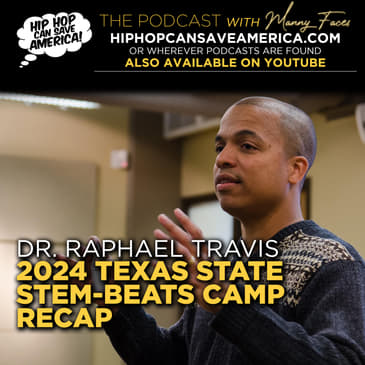
In this episode of "Hip Hop Can Save America," Manny Faces talked with Dr. Raphael Travis from the Texas State University School of Social work about the transformative potential of Hip Hop in STEM education and youth development. Dr. Travis shared details about the federally funded STEM-BEATS summer camp program he facilitated, explaining how Hip Hop culture encourages students to explore and innovate in fields like science and technology.
The program introduced activities such as using AI and haptic vests for music, podcasting, and creating beats, aiming to make STEM education more engaging and accessible.
The conversation addressed the broader applications of Hip Hop in education, therapy, and conflict resolution. Travis mentioned, "Hip Hop culture is an enormous, rich archive that can help individuals and communities heal, thrive, and innovate."
Both Manny Faces and Raphael Travis emphasized the importance of Hip Hop in fostering life skills and bridging generational gaps, while also discussing Travis's upcoming book on youth violence prevention. This episode offered a deep dive into the potential of Hip Hop to inspire and educate the younger generation.
If you value this work, please support at www.patreon.com/mannyfaces
SHOW LINKS
https://www.rutgersuniversitypress.org/the-future-of-youth-violence-prevention/9781978833777/
https://www.bloomsbury.com/us/healing-power-of-hip-hop-9781440831300/
[00:00:00] I am Brother Cornel West and this is Hip-Hop Can Save America! I'm Brother Cornel West and this is Hip-Hop Can Save America! It's smart, it's insightful. The way that they can communicate a complex message in a very
[00:01:11] short space is remarkable and a lot of these kids, they're not going to be reading the New York Times. That's not how they're getting their information. Let's talk about one thing that we did or that you did. I mean, I was just a small part. This
[00:01:49] summer tell me, Dr. Travis, about the wonderful initiative now and it's something here. The STEM Beats Summer Camp Program that you facilitated there. Give us a rundown of what it was and what it was about.
[00:02:04] Well, first and foremost, I want to thank you again for setting the tone for the audience doesn't know, but you are invited in to really be a keynote welcome speaker to introduce the
[00:02:18] whole thing. So it was a month long camp once a week. The last week was twice a week. We called the STEM Beats Camp and really this was to open the door to STEM thinking and STEM
[00:02:33] exploration for young people, a young people high school age. From ninth to twelfth grade. The way that I see it is there are a lot of STEM initiatives. It's kind of a hot
[00:02:44] topic. It's been over the last 10, 20 years or so. So we have a lot of major STEM type companies, engineering companies bringing people in and things like that. But the way that I see this
[00:03:00] summer experience is kind of that in between. So I don't want to necessarily have you go and become an engineering major as soon as you go into college. But what I want you to do is think
[00:03:14] of yourself as a scientist. Think of yourself as familiar with curious about technology. Think of yourself as having an engineering mind. Be curious about how math basically underlies everything that we do, particularly as it relates to music as well. So we use hip hop
[00:03:40] culture as that lens to science, to technology, to engineering, to math. And because people love music so much, because people love hip hop, all the ways that we try to make those connections, it resonates because they're interested in it. So it's really a great
[00:04:00] experience and the other part that we try to do is introduce something new. So every year I'm thinking about what will be the new thing that we explore, try out, investigate.
[00:04:14] And it's kind of like a buffet. And we try to expose them to as much as we can around STEM through that lens of hip hop. So for this year, some of the new things that we
[00:04:27] did, AI has really taken off over the last year compared to last year this time. So we did a section with Lupe's text effects, that partnership that he did with Google. So we brought that into one of the activities where we had them think about generating their
[00:04:47] own lyrics in general, but then what happens if you add this other layer and then talking about large language models and the thing that underlies AI, so bringing all of that conversation. So it's as much learning as it is creating. We also introduced a haptic
[00:05:07] vest this year. So haptic devices are the type of, if you're a video game player and you think about the feedback on your remote control, vibrations. So that's a haptic device. And so they have vests where you can feel the music. Timberland first
[00:05:27] introduced it way back. I can't remember exactly what the name of his product was, but that's sort of gone by the wayside. But there's some other folks that have kind of continued that technology. And so we introduced that. So you're feeling the music. And
[00:05:45] that's an area of research that I want to kind of move into. Most of the research around that is done with the deaf community. Right? So these are like these open up lives. Yeah, exactly. And so part of what I'm curious about from a research standpoint
[00:06:02] is, you know, we know that people reported as being more immersive experiences with music. So all the things that I'm interested in in terms of using music to promote empowerment can be enhanced with some of these haptic devices. We introduced podcasting, which
[00:06:21] is something that we hadn't done before. As a way of thinking about evaluation, you have your typical focus groups and things like that. But we tried out, okay, what if we had them initiate a podcasting experience to talk about their experiences as opposed
[00:06:39] to us asking these questions, right? Yeah. Introducing them to learn how to work the board and how to facilitate all those kinds of, you know, social emotional kind of skills in addition to the other things that the technical functional skills. So, you know,
[00:07:00] we also so each week we'd have a pop up museum, right? So we focus on one of the themes each week. So first week was science, second week was technology next week was engineering.
[00:07:11] And so within that, we'd introduce a bunch of things. But we also sort of featured a pop up museum where they had these interactive exhibits that they could read, they could see images, they can learn. And so that's a way to introduce them to even more topics
[00:07:26] and more people that are in involved in these different areas. But again, all through the lens of music hip hop culture technology. Just an incredible experience. We had some great guest facilitators. Aside from yourself, we had Ellie again was a guest producer. So
[00:07:48] each year we have a guest producer. It's not as much focused on creating a song or music product like mixed state camp, which is another initiative that collaborate with Ian Levy with. Yeah. So this one is more learning and well being sprinkled in there.
[00:08:08] But we do have them create a create a beat and create a video to go with the beat. But it's not as much around lyrics, lyric creation. Although we do have we did have that exercise, but we didn't bring it together to like create a song. Yeah. Yeah.
[00:08:25] It's just it's the rundown of activities is like, God, man, I went to camp or just run around outside and then come inside and get juice and then go back outside. That was camp for me. I didn't
[00:08:40] I, you know, I played a sport maybe this would have been fun and exciting. What were I'm not I don't know the makeup of the the the this was all community, you know, young people came from,
[00:08:51] you know, local area. I don't know their makeup in terms of like how much access they might have had to, you know, a lot of times we see these initiatives to, you know, really supplement
[00:09:02] what maybe isn't there in in schools. And maybe that's the case here. You know, generally speaking, you have to do it outside of school to kind of supplement what they might not have in terms of
[00:09:12] STEM oriented classes in the school. If that's the case. Okay. And either way, what were some of the what did you see as really eye opening for young people? Like what would like something that might have happened or or something that they just never had thought of before
[00:09:34] or had access to. For me, I think it's the freedom to explore. I think, you know, so we have just to help the list of psych. So we have a full studio here in the school social work at Texas State. And so it's a real
[00:09:52] studio with six stations. So every station has the computer has the software has able to push has a keyboard. We have we also have two DDJs at two of the station so full size DDJ turntables.
[00:10:11] And so the point being is that people are often intimidated like, you know, they come into their space. This is not for me either. I've never done this before only those type of people not in a negative way but like, I'm not a DJ.
[00:10:26] I'm not a right. And so they're hesitant in general and then people that are shy it's kind of double right. Right. And so once you open the door though, you know one of my favorite activities is an activity called clip jamming it.
[00:10:44] This I got this from Alex crook he's a he's a great colleague of mine he's in Australia. But essentially you're setting up the MIDI device so to trigger tracks or to trigger clips so that if you set it
[00:11:01] up right no matter what you pick it's going to sound good.
[00:11:06] Right so you picking your baseline you're picking your kick you put kick picking your snare your melodies all if you set it up right no matter what they pick it's going to sound good, but they don't they don't know that they're intimidated by.
[00:11:20] And so what happens if you bring some I've never done this before I'm not a musician, you know and they come and once they and you know if you do it collectively it's going to sound good.
[00:11:31] It's even better because you get that community experience right have everybody pick something so you got five people and all of a sudden they created a song in three minutes.
[00:11:42] Right, they're jamming they're excited. And then you if you have them, then you know what I say perform it right so you take the clips that they chose, and then they could, you know bring in maybe they just bring in the melody first and then they bring in the base right.
[00:11:57] Right, so allow them to kind of perform it right add some effects without hearing it you know the.
[00:12:04] And in 10 minutes like they've done more than they ever thought and once you open that door yeah the confidence is there the freedom, it just changes their idea of what's possible.
[00:12:20] And so then all of the different things that we introduced me like that let's learn that let's learn this or something that right and opens the door so the reason that I like it is because.
[00:12:32] So and we've done other things like the mixtape camp which is great right they come together they make a song and incredible outcomes, the reason I like this because we're able to throw a lot at them. Right and expose them to lots of different things.
[00:12:48] Yeah, and so by the time they're done my goal is that they can walk into any space with technology and things like that and they feel 100% comfortable.
[00:12:59] I've seen this I've done that I've explored this this is not for them this is for me yeah you know what I mean yeah.
[00:13:07] I say like we look at the young folk and we know that they're natives the digital natives they could work a phone you know what I mean like they can make videos that are like cinematic cinematic on their on their iPhones or you know androids if you like me and you're the better person but you know.
[00:13:23] But you know you know but and so they're amazing at what they could do, however, that's not all the technology that exists in the world that's not the technology that necessarily go find in a workplace, or they're going to find it in a technical setting or you know like a training setting, or again you might be really great but if you want to get into music production that is intimidating or podcasting or you know this kind of audio field or or you know any any medical field that has medical technology.
[00:13:53] So what you're doing is again you're showing them the fun way that they can feel comfortable interacting with technology that isn't their phone. Right so that all his parents say I don't want them on a phone.
[00:14:04] Okay well there's other technical technology based things that they're going to like doing as well and pick up on it because they are digitally natives and they are smart you're going to say.
[00:14:12] And we're talking to them about what's behind the scenes like what is going on so we're trying to give them that knowledge as well right. Right.
[00:14:22] So you're doing this so okay well what is a MIDI device right what is it's moving from MIDI 1.0 to MIDI 2.0 what's the difference right right we're using text effects to enhance use AI to enhance what we've created well how does it know to do that how does it know to feed us these ideas oh large language model what's a large language model.
[00:14:45] Right. So we're trying to do a little bit of both that's why going too deep doesn't always help because you lose the ability to kind of touch on some other stuff so I feel like it's a great balance of experiential and that learning component.
[00:15:04] Yeah absolutely a couple of questions why is it not popping up but there was popping up earlier dang it I'll have to read it used to pop up on a screen on the other thing.
[00:15:13] I'll get it guys I know it worked on the other screen I figured out Andrew Wangs asking because Andrew Wangs again a music educator and he's very tuned into this conversation how long you with the students every day how long are these sessions.
[00:15:23] You said it was a how many weeks and how much time per day. Yeah so we started out in from 11 to 4. For each of the five days. Once a week for a month. Right. After the first week. It's kind of a funny story. This in the second week.
[00:15:49] I got a call. It was like nine o'clock in one of our admins was like so your students are here. And I was like it doesn't start till 11 o'clock.
[00:16:01] But apparently from the parent dropped them off and there was a student there so like OK well I guess campus starting now. Right.
[00:16:13] And so in what that kind of brought up is you know the realization of transportation is an issue for parents right and so it's a lot easier for them to drop them off early so they can go to work.
[00:16:24] And then you know as opposed to coming out 11 o'clock makes sense. So what we did is we introduced the idea of pre camp. So from nine to 11 people that wanted to come early could come early so we essentially started at at nine.
[00:16:40] And then after that second week everybody loved it so we did that for the rest of the camp. But essentially it's a full day. Now at the end of each year we always talk with the students what you like what didn't you like.
[00:16:54] And one of the consistent things was they wanted more time. So we've explored we explored some different iterations of like what did they mean by that.
[00:17:07] And it sort of settled on what would be not too overwhelming but better would be twice a week for the you know for I got it for weeks so.
[00:17:18] You know it's a little bit of a funding and bandwidth thing whether or not we'll be able to do that but.
[00:17:26] More as much as we are trying to introduce them to and to give them a little bit more breathing room around some of the things that maybe they like a little bit more and they want to spend more time with.
[00:17:39] That is something that I'm definitely going to look into to see if that's you know that's the way we want to go next time. Follow up question you just mentioned funding and I got the thing back look everyone I got the thing back.
[00:17:53] Is this all through donations or fundraising how was how was something like this funded obviously there are folks who work in these school districts and such it's a great program you talk about a lot of funding necessary for this how did y'all do it.
[00:18:04] Yeah, this is a part of a long standing collaboration that we've had with the trio program.
[00:18:12] So we have this is a federally funded program may have several different ones you may have heard of upward bound you may have heard of talent search used to be called rural talent search.
[00:18:23] And so this has been a partnership with continued partnership with trio and they've been really great it's kind of the best of both worlds it really meets the needs of a lot of what they're trying to do around stem and bringing innovative.
[00:18:43] You know kind of evidence informed work in stem but things that young people want to do. Yeah, yeah. So there's been a really, really excellent collaborator.
[00:18:56] Yeah, I mean some people may or may not know you may may not you know I do I do a PD you know a whole professional development for K to 12 but it really functions a little bit better from like 7th to 12 but whatever I've done in a couple of school districts and it's basically it's the it's the hip hop can hack everything and it's basically
[00:19:12] saying how do we incorporate hip hop into the steam classes. The ideas of you know hip hop being one of the most ingenious inventive ingenuity filled social art form cultural movements in history.
[00:19:26] Everything was born off of innovation and hip hop hip from the from the very beginning the people say it may you know we made something from nothing I like to say we made something from everything and as the grandmaster
[00:19:39] has quote that hip hop didn't invent anything but it reinvented everything and reinvention is the mother of innovation you know to mean like that's where that's where innovation comes from what we're talking about here is you're talking about introducing kids to science technology through music.
[00:19:56] What we talk about in this show all the time are these intersections that just spark interest and and immediately from the giddy up you're saying this is innovation and his hip hop has been littered with this from grandmaster flash
[00:20:09] into two turntables and harken them from you know reengineering the the the mixers reengineering the turntables reengineering the sound systems taking the electricity from the pole you know all the way through the idea that mix tapes how hip hop was
[00:20:24] propagated throughout the world through the use of this technology that it wasn't really designed to do but then that's how and then that came into them the entire mix tape market which up into the entire record industry which then turned into streaming and P2P networks
[00:20:39] and hip hop's been at the core of all of these technological advancements you know through the beginning of time so if you want to touch if you want to connect those dots and get anybody who's young to see that their culture that the music in the culture that they love has actually been one of the most prolific
[00:20:58] you know ways to change the world technologically since it started 50 plus years ago this is the way to do it.
[00:21:09] And I think consistently over time as I've you know talked about this innovation that story of the turntable and turntables and mixing and scratching and sampling and is the thing that consistently captivates young people.
[00:21:30] And then to actually be able to go and you know mix on the DDJ and learn about key points and things like that learn about you know wavelengths and see the visual wave file.
[00:21:43] That's the that's the most consistently appealing, you know, regardless people are just fascinated by that evolution.
[00:21:51] You know the the loose theme for tonight is hip hop for the children because again what I want to what I like to fight against is the knee jerk reaction when people even us even of the culture even you know people familiar with hip hop love hip hop grew up in hip hop.
[00:22:09] Think that today's hip hop that hip hop today doesn't have any of these you know qualities doesn't have any of these because they're so the knee jerk reaction and we're all guilty of this to some extent.
[00:22:19] Is that when we think of hip hop we simply think of like rap music that maybe is on the radio or whatever our kids might be listening to on tiktok or you know what at the moment.
[00:22:29] And while that's still the front facing and most lucrative aspect of the culture. It's just that it's an aspect of the culture.
[00:22:36] And when you say you can get kids excited to learn how the music is made. The same way we got excited when we first you know started messing around on a turntable or you know or heard new sounds like you know people say what's your moment what's your song when
[00:22:52] When did you fall in love with hip hop the you know the internal question and I will it was my melody by rock him because sonically and like my dad was a jazz and blues guy and do up in the heart and soul and we were his 80s music and as we had we had we were being bombarded with we had sounds from every possible
[00:23:13] You know era but when that drop I'm like this is something my mind was like this is a different sound and so what I wanted to see then then soon after that I got a drum machine and I started DJing on my dad's turntable which he did not like you can not do that.
[00:23:30] You know but I did anyway because I wanted to learn how do they how are they doing scratches like that how are they making the beat patterns like that I wanted to look and it excited me and if we think that today because kids today wouldn't be similarly in you know infatuated with the technological
[00:23:50] Yes granted like there's a lot more access now you can do people got fruity loops in there they got garage band they got you know but hands on in a in a in a in a setting like this it just got to be so Validating Yeah 100% and
[00:24:08] And you know and we've had the chance to talk in the past you know like my wheelhouse the thing that I love the most out of the culture I love it all yeah but I really like lyrics I like lyrical analysis I like playing around with words and trying to make sense of you know what is this saying about me what's it saying about the world
[00:24:26] And so that's like my sweet spot but I love the rest of the culture and it's so exciting that other that young people can they can guess just as fired up about it they want to go home and they want to practice it and they want to figure out you know
[00:24:42] It is incredibly validating and until your point in helping people understand the culture is big you know there's there's so much to learn and because of innovation the technology is going to continue to grow it's not does not stop it you know yeah and we got as as old a folk that sort of our responsibility is to remember that you know I said this
[00:25:12] Last week this may be relevant I was supposed to play it earlier on this note because we talked about another camp another that was facilitated by the college UNC did a summer beat I forget what they called it you'll see it in a second and I made this point and let's see if it plays so I want to make sure that I know how to play things.
[00:25:31] Carolina Hip Hop Institute same kind of deal summer school students dive into beats at the music departments Carolina Hip Hop Institute they learn to make beats rap and DJ what I love about this and I talk to people that do this kind of work all the time is there's a lot of people outside of the culture that might say hey you know who cares why are kids in summer school like doing rap and beats and stuff
[00:25:54] and you know it may seem like it's a frivolous activity or waste of time especially if you have a negative perception about hip hop and all the things that it offers to the world but we know we who advocate and love hip hop music and culture know that the music and the culture offer so many things besides what you may attribute to it so when I hear even our own folk you know even our own hip hop heads talking so many terrible things about the culture and I'm like yeah but this is happening too
[00:26:24] and when you have a summer school that where kids learn how to make beats rap and DJ they do it they're being instructed they're being shown by the elders so they're learning that respect for the for the elders respect for the craft respect for the old school but also we're not saying hey you got to do it like us show us what you got young folk like there's a mutual kind of thing here
[00:26:44] happening and if that's not like a use of hip hop for the greater good I don't know what is because we always talk about this disconnect between generations and getting them to understand and respect and use it as a form of expression and they're literally doing that all over the place this is just one of many that we talk about at the Carolina
[00:27:04] hip hop institute at the University of North Carolina so we wanted to shine light on that because most people don't think these things exist they only have this negative perception and it's having kids being in a safe space learning how to express themselves learning how to interact with technology learning how to interact with their cohorts like oh you make beats oh I wrap let's work together oh we need an artist for the for the for the mixtape cover and these summer camps are just invaluable as I always say every failed
[00:27:34] rap you know every every person who aspired to be a rap artist one day myself included couldn't be like silent night who ends up being a recording artist and rock his records and puts out records and does songs with inspecting deck and does all this great stuff
[00:27:49] we rap too like we just never got there but what we did was we learn how to communicate better we learn how to express ourselves better we learn how to be a better public speaker maybe that helps us in in our job or in our school you know schooling or whatever and that's what hip hop can do even if you don't become a star even if you don't go out and you know make it in that in that business these are transferable life skills so when we see something like this we big it up over here and we say now whatever you or your people's are thinking you know there's a whole lot more to it than that.
[00:28:19] Hey I'll just jump in here real quick it's many just to remind you that this is the view is taken from our full live stream show that airs Monday nights 9pm Eastern on YouTube you go to hip hop can save America dot com slash watch that'll send you up into the YouTube page it's also you to dot com slash many faces if you wanted to go there and that's where we're usually at Mondays at 9pm Eastern also if you feel like any of this is valuable please become a sustaining member of the show and the movement you can do that at patreon dot com slash many faces and also if you like this content as a free newsletter hip hop
[00:28:51] can save America the newsletter that's free although you can donate there as well and that's at many faces dot sub stack dot com so patreon newsletter and come see us live Monday nights. Alright let's get back to the episode thanks.
[00:29:06] Just to remind people that it's up like we can't sit back and say the young folk don't know about the culture if we're not taking the time to teach them about the culture and all the you know all the elements in it and and it's being done so I would encourage folks
[00:29:23] parents you know elders folks who love hip hop and and you know unsatisfied with the direction that is gone you know I mean it's fair not a lot of places advertise it not as hard to find some of these places if only there was a guy who did a show and have a newsletter and you know so maybe
[00:29:39] maybe some come my way but until that day you know we encourage folks to at least know that this stuff exists at least know that the wonderful things that that we know hip hop to have do exist and folks like you sir are helping that you know continue
[00:29:54] we see Andrew said that's why music teachers should go to steam conferences and steam con teachers should come to music conferences.
[00:30:01] You know we go to academic conferences all the time and some of them are you know like you're so you know you've done social work you're you're you know you've done that and that you go to you're probably the only hip hop guy there sometimes which is in one hand cool because then you get to be the expert the thought leader and all that stuff but you're like you know a lot of my
[00:30:19] hip hop and or you know even artists should be at these conferences so that there could be more trading of these ideas yeah. 100% and you know the reality is you know.
[00:30:32] Envious of hip the hip hop community in regards because they there are established there are people doing different things like within our field.
[00:30:42] You know like I said I'm super into lyrics I'm I talk about the landscape of all the different things that people do because I want people to be aware of all those things but really you know your next week guest.
[00:30:55] You know could be talking about DJing and you know therapeutic uses of DJing and then you know beat making and then graffiti and you know or even within lyrics you know somebody specializes in Southern hip hop and where you know what I mean like.
[00:31:11] I mean there should be all these different permutations of using the culture for learning and growth but we're not quite there yet. But I'm hoping that we get there.
[00:31:23] Yeah you know what we're doing at work and again the point I made with Shasta Chosen hip hop prism in the building each generation and I review things a little differently so you have to engage them in a way that's interesting to them if you ask them they will tell you and we do this a lot here but again first timers people coming across the show just getting this gem is that the
[00:31:41] key is that it's a two way thing like I mentioned in the clip that it's you're getting this not we're here to show you how to do hip hop we're here to give you the background and give you you know just how we saw it but also what do you bring to the table and now those two worlds come together it's actually now something new and better just real quick we often talk about the generation gap problem and hip hop.
[00:32:01] And in life right we don't these darn kids we don't know how to communicate with them we don't know how to talk to them. Just your your work overall but you know just thinking about the camp you put together.
[00:32:15] How how how much of a key is that to listen to the kids about their interpretation of the culture that we love and finding that common ground.
[00:32:25] You know I spent a lot of time in that space and kind of where I've settled on it is because there's so many different ways you can view it but one of the ideas is thinking of it solely through a youth lens right this is a youth culture I want to understand what they're listening to and all that to the exclusion of other
[00:32:48] other generations right I like I'm so attuned to what young people are doing that we sort of dismiss the other stuff.
[00:32:58] And what I try to do is in the same way that I focus on what might be empowering is is what might be risky try to sort of balance those and explore both. I try to pair what I call classic.
[00:33:12] To newer something that's newer right because what I'm most introduced interested in is what is most empowering in the culture right so things that help us feel better do better be better better connect and belong to to the groups that we identify with better conditions for these communities that we care about that's what I'm interested in pulling from
[00:33:37] hip hop content whether it's songs or art or dance or whatever right and so that's what I'm introducing young people to those themes of empowerment.
[00:33:48] And so I'll take something that maybe it's classic and we'll explore those themes and then we'll look at something that's newer and explore those things are do you see that do not like what stand out. Yeah.
[00:34:00] Right and so I try to do both of that because I really feel like we are often missing out on the richness of you know you you do a lot of work with summer in this idea of archiving right yeah and and that's really the way that I view the culture right we have this enormous rich archive of
[00:34:24] things that can help us heal individually and as a community as well as as thrive and grow and create and innovate but it just gets thrown away right we just it's just it often feels disposable in the way that we treat previous generations of of of hip hop culture.
[00:34:47] And so I want to teach young people to be curious about anything that they're exposed to but have the tools to explore themselves in the world. So that and this is what I really found by doing that. There's a different appreciation for older content. Right because
[00:35:10] they're not necessarily looking at it to jam to per se right I try to pick stuff that's dope. Right you know what I mean. But they're looking at it with oh this oh is this here.
[00:35:21] Oh OK I see the I recognize right I'm going to ask and it's something that is important in my life right so you know I do care about how people cope when things get difficult right.
[00:35:36] And so I feel like those parallel processes help a lot in kind of you know Chuck D was the first person that I've talked about this for a while and he heard it in an interview he mentioned a couple weeks ago and he talked about there's like 10 generations of hip hop and I've been saying this.
[00:35:58] Right. And essentially every five years right so. It's not a generation like the way we think of it or yeah it's it's it's accelerated.
[00:36:08] Exactly you connect with the content the stuff that you loved in high school and maybe a little bit in early college right that's the stuff that gets people fired up. Yeah right across the board.
[00:36:19] Yeah right so you go to any group of people put on songs that they jam to in high school and early college or there's been research there's been research on this is legitimate like that your formative music is going to be that age right.
[00:36:32] So you know you're going to be in a range across the board. Okay what genre who you are where you live what you're about. Exactly so this idea of hip hop. We need to think about in that way right so.
[00:36:45] Of course when I jam to the you know somebody else is not even just 1015 years younger than me is going to.
[00:36:51] You know I mean there's some classics that endure but the thing that the things that really touch you that resonate that make you move that that you know all the bells and whistles like for for my generation you know with that
[00:37:02] Pete rock in common you know you hear you hear the Pete rock horns and the jazz stuff and the scratches. It feels home.
[00:37:09] Yeah exactly home yeah I mean so everybody has that home and I think that that's what we have failed to take advantage of because the things these empowering message these are universal and these are universal across music genres.
[00:37:24] I know you're wrong but hip hop has a depth, a nuance, a descriptiveness and a density to be able to describe into to to to to reflect those emotions in those experiential realities in a way that's really unique and powerful.
[00:37:46] And if we were able to kind of really tap in each generation to some of those things I think there's a lot of a lot of growth that is possible.
[00:37:57] I hear that and you know first thanks for saying things that I think I can say and you just say them better. So thanks for being smart and stuff.
[00:38:08] As chosen hip hop says we call them errors of hip hop there are these errors you know we've talked and then you know there's there's more than one possible golden era depending on who you're talking to this I've heard arguments for two different golden errors.
[00:38:21] Well which one you choose at which one 88 or 92 93. That's the thing like I actually might. I would feel more inclined to say the 88 era you know because that's obviously was my golden era but I think that the 90s, 93 94 like that.
[00:38:36] That kind of world was sort of that sweet spot I think that's pretty universally agreed upon. But again, you know depends on who you talk to. But that's why these discussions have to be had they are nuanced there is no one answer.
[00:38:47] You alluded to it earlier we're not even going to get into that but like sort of like even the origin story of hip hop has been, you know, is something that there are multiple timelines as Macau my man
[00:39:00] McAllum mean would say these these sort of variants you know off of the main timeline using them the Marvel analogies.
[00:39:07] Or as I would say like a tree and branches actually both kind of simultaneously come up with this idea and said okay, there are these branches that come off a hip hop and they all kind of come down
[00:39:16] but even the trunk of a tree has roots man and it goes from different it's so complicated and so and use the word nuance and that's how I look at it.
[00:39:22] So I just want people to know after hearing us talk and hearing the work you do how important it is to not have a for lack of a better term black or white, you know cut and dry this or that a and b binary view of what hip hop is under no circumstances is that helpful to the advancement of the culture to the preservation of the history of the culture.
[00:39:47] There are things that we may not like but it's all part of that tapestry. And it's what we choose to do with it and what we choose to amplify and signal boost along the way that as as old a folk as elders.
[00:39:58] That's on us, that's on us and this is in your camp you're in a position to do it because you're in a you know an academic facility and you can get funding and you can do these things.
[00:40:07] Parents I always say can you know learn about hip hop and you know type stuff and go to the board of education and say hey do we have this in in our school district because I've heard some things that this this could be really instructive.
[00:40:19] You know Andrew Wang is in the school system says sometimes he has to push against the act push push for these programs yes to push up back against administrations that don't understand all this stuff okay.
[00:40:29] Hell if you work in public relations and want to spare a little your time to help us craft publicity campaigns like you know PSA is for hip hop being.
[00:40:37] You know the ways that you could help save children or improve their their standing in life then donate your time as a PR executive like this things you could do grown ups to help this cause and so like I said this is one of the ones one of the ways that you do it.
[00:40:51] It's through this program and of course the book and just you know talking and just being a cool ass cat I can talk to you all night obviously about this I don't want to keep you up for too long.
[00:41:01] Tell folks right now like what you're working on now what you got going on and then obviously you know tell us about hoodwink and you know and then we'll let you get out of here.
[00:41:10] Yeah so right now we're kind of ramping up or got a new book that will be coming out slightly a left turn but not really.
[00:41:21] You know my main area that is a biggest interest to me is just positive youth development regardless of whatever mechanisms that are in place to help promote positive development that's what I'm about and so I was super excited about a project that I worked on.
[00:41:39] On with my good buddy Paul Boxer on the future of youth violence prevention it's called a mixtape for practice policy and research. Got up the screen right now out of Rutgers big up Rutgers.
[00:41:54] Yeah yes so it's really funny this has actually been sort of an idea that was hatched decades ago we met way back in the days when we still doing our doctoral work at what we used to call violence camp.
[00:42:09] That sounds like the camp I went to when I was talking about. Youth violence prevention fellowship that we had and every year we meet up for a conference and things like that so yes that's where we met.
[00:42:22] We both had just a huge passion for music and so you know we've been in touch he's a great researcher does a lot on violence prevention.
[00:42:32] And we talked about this idea of the mixtape you know what's great about you know and there's different iterations or variations of what people call a mixtape but in general the idea of you creating as a DJ if you're doing formal mixtapes or whatever as a person essentially you're creating the best of according to you based on may have some old stuff may have some new stuff.
[00:42:58] Thinking about hip hop mixtapes where you may have a classic beat where somebody's freestyling over it right you know jacket for beats.
[00:43:07] Right yeah I have a fresh blend you know Ron G style you know what I mean but this idea where you know you bring together ideas proven innovative well heard of and established not so well heard of.
[00:43:27] And a big part of you know as an editor you're bringing together lots of voices and so in many ways.
[00:43:37] An edited volume is an experiment in and of itself right we had some ideas about what we might get back but we were you know you're not sure until you get back what you get back.
[00:43:47] But a big part of what we assumed was that you know when you pull together people that are doing all sorts of things that there's likely going to be some common ingredients right so some some underlying principles and ideas that cut across whether you're talking about community
[00:44:06] gardening or hip hop based approach or credible messengers or a hospital violence prevention program or you know for people that just got shot and trying to help them not retaliate right that if you pull all these things together there's going to be some.
[00:44:26] Consistency and what people feel are effective beneficial and things like that.
[00:44:32] And that's really what we wanted to do and the idea was OK who would this be helpful for right it's really helpful for anyone that is involved in a program that touches young people with the goal of.
[00:44:50] Preventing violent experiences so that's kind of the way I talk about it. So even thinking about that term preventing violent experiences right when if you think of just youth violence prevention people have stereotypes of you know getting guns off the street and things like that.
[00:45:08] But if you really think about youth are exposed to violence in lots of different ways. So if you think about even even you know parental abuse and neglect right or you're thinking about oppressive systems that are marginalizing young people and our assaults on their identity.
[00:45:27] Right those are types of violent experiences and so we really try to cut across the landscape of you know what people think when they think about youth violence prevention cutting edge research I mean the people that are.
[00:45:42] Assembled. Oh my goodness this is like a dream team of people we were we were both crossing our fingers that people would say yes to our invitation to be a part of this book and it was just amazing the response that we've got.
[00:46:00] Looking how many yeah so we've got 26 chapters and I mean who's who of people that are involved in this type of work and so really excited comes out in December.
[00:46:14] I encourage you to check it out. There's there's two chapters in there that talk about hip hop so I have a chapter in there. Nice and Dr. Abdullah deal out of Chicago runs an incredible program.
[00:46:28] He talks about the evolution of the program and the work that they're doing but just to really innovative and exciting things in here.
[00:46:39] Very dope. Like I said head up on a screen the future of youth violence prevention is named in the book I will put the link in the chat as well even though people who watch probably know how to use Google but just in case it's up there again shots to Rutgers University
[00:46:54] we know my dad went to Rutgers my dad guy's PhD from Rutgers.
[00:46:59] The only college that I claim because I didn't go to college but he went to Rutgers so I kind of can claim I did go to a business program there it wasn't college but it was like a community when I lived in North for a few years.
[00:47:11] So I claim Rutgers so I like Rutgers so yay to them for doing this and the ADU for putting this out looks looks fantastic it's something that I think like you said anyone who's charged with the care of young people could benefit from something like this.
[00:47:26] You know we talked to some folks it's a great sub field or whatever you want to call it sub genre let's stick with the musical analogies. You know we've talked to folks like Mark Katz who does next level you know and their their hip hop as culture transformation.
[00:47:44] Conflict transformation as opposed to conflict resolution like there's a whole thing about they you know never going to resolve you got to transform it as something else which obviously sits at the heart of hip hop and so.
[00:47:59] The idea that that hip hop has these unique characteristics that can be applied in these ways and explored.
[00:48:07] That's they kind of international but youth are youth right so I think that it's a it's a beautiful thing to focus on and I applaud you again for just you know. Just doing all the good work man.
[00:48:22] I appreciate it man and again much respect to you for this platform there really aren't places that we can talk about this stuff with an appreciation you know not to get a quick sound bite or to try to fit everything. In you know two minutes of conversation.
[00:48:39] You really open the doors to to have thoughtful meaningful conversations about this type of work in and really like we were talking earlier to really try to create possibilities for people to branch off and do their own thing in these areas you know.
[00:48:57] Yeah that's the idea and I say y'all inspire me so anything you see me do it's because I've come across folks like you and you know we obviously come from the same neck of the woods but you were someone I found very early obviously the healing power of hip hop is such a seminal book and when you find the people are using this thing of hours to you know literally save lives
[00:49:15] literally improve you know lives livelihoods and communities and especially and most importantly you know communities that have been traditionally you know underserved and under resource and under loved from you know the rest of society it's just such an important.
[00:49:28] It's just it's the mission it's the work you know as as as ended would say you know it's the work this is the work. But this is the work this is the mission and so I appreciate your work very much.
[00:49:39] Once again folks you see him IG at rap TJ are on Instagram and of course you're on discord you got a great discord is popping and you share a lot of mixes and you do mix tapes yourself tell people where to go for that and then we'll cut you loose.
[00:49:54] Yeah so so I do do mix tapes under DJ hoodwink you can find those on mix cloud. The most recent dropped probably about a month month or nothing a half ago.
[00:50:06] And so I try to get those out and it speaks to a lot of what you talk about man the really the goal of that is only new music.
[00:50:16] So right when I when I do those mixes it's current music and that's a big part of is to help people understand there's always don't music drop yeah always every week.
[00:50:28] And so so as part exercise to try to filter out like what is the thing that resonates with me sonically what is the things that has a lot of those messages that I think are important when we think about that self reflection.
[00:50:46] And self awareness and self help and yeah if we are therapists or counselors what is some content we might want to use in our work with young people to explore these topics so that's what those mix tapes are about.
[00:50:59] Right and that's super valuable just to jump in I know Andrew you know we've talked also about you know having to work with other you know maybe not school school adjacent you know we have we do it for the culture you know these organizations and they're always looking for music because they want to play music that that you know we're
[00:51:16] not going to be able to flex these things and sometimes like we don't we're not that tuned in so these are valuable resources you know to be able to say hey here's some new music.
[00:51:25] Kids gonna recognize the artist or kids gonna recognize the vibe and it's not you know not everything is crap people so yeah so thank you super valuable super valuable yeah yeah.
[00:51:38] And at the end of the year I do my top hundred so you know narrow it down so every and that's something for people you know in the audience if they want to kind of look back you know been doing this for four or five years and so there's volumes of content that you can check out.
[00:51:54] I got the link in the chat and I'm just like scrolling through your your your catalog now sir again like all these things you write you write all these books you do all these things you have 97 mix tapes I have one I have one mix tape.
[00:52:08] And I still haven't done the book so anyway what we're getting there we're getting the crowdsourced our support of the culture so it's okay everyone. You know my mix is your mix my book is your book.
[00:52:22] It's all good it's all good quiet as kept I haven't made anything officially noticed but there is a book coming and it'll be here. All right.
[00:52:30] And it's official I didn't just draw it on an napkin so anyway we'll talk about that later listen rap I'm so glad that I know you and that you came back and told us it's just an honor to be involved in your in your initiatives.
[00:52:41] It's an honor to just know you and talk to you and anything you can anything you do that I can amplify you know the door is always open.
[00:52:49] And you know let's see what happens and hopefully I'm sure you'll do one again next year I'm sure the camp is going to be live direct and also thanks for talking about it because you know what I think what I would encourage is folks in other institutions to say look at the blueprint.
[00:53:03] You know hit you up I'm sure you'd be like no this is what we did man that's how we made it work like you can do this sort of thing over by you and you know.
[00:53:10] That's something I always think about like maybe taking like some of the stuff that that you know you and our friends elsewhere do and maybe you know finding a way to you know do it somewhere else and replicate it or you know branch it out branch out like you say branch it out and do our own thing.
[00:53:24] So thank you for sharing a blueprint that's you know we don't gate keep around here we share the information as each one teach one you know in the in the in the in the in the hip hop. You know. Conception. Yeah the Constitution. The commandments.
[00:53:43] So thanks again man anything else or we good. No man as always brother appreciate you and your work thanks for the invitation. Strong Island continue to represent. That's right and I'm next man on next. I'm on now. It's gonna be a good year man.
[00:54:00] I mean I gotta see what happens at the center situation but I think we'll be all right. I think we'll be all right.
[00:54:05] We got some Nick's fans in the building you know I'm not I'm wearing the I got the Giants on today but but you know I'm usually Nick or Yankees out but Nick's all day baby let's go. Thank you my friend. All right brother we'll talk soon.
[00:54:18] Once again thanks for listening to another episode of hip hop can save America a K.A. the world's most important hip hop podcast. My name is Mandy faces you can find out more about the show at hip hop can save America dot com.
[00:54:29] You can watch the show now as a live stream on YouTube hip hop can save America dot com slash watch check back for all the replays as well.
[00:54:37] The interviews from the live stream will be brought here onto the audio feed so you always get the best of the live stream.
[00:54:43] You can also check out our sub stack newsletter it's free at many faces dot sub stack dot com filled with stories of hip hop innovation inspiration and in general hip hop news that isn't about dumb.
[00:54:54] Eternal shouts to our consulting producer summer McCoy be sure to check out her dope initiatives hip hop hacks and the mixtape museum.
[00:55:02] We'll be back soon with another dope episode but check us out on the live stream as well Monday is 9pm Eastern hip hop can save America dot com slash watch until next time. Many faces wishing peace and love to you and yours.

WATCH
HIP HOP CAN SAVE AMERICA!
LIVE ON YOUTUBE
MONDAYS, 9PM ET
WITH REPLAYS ON DEMAND